
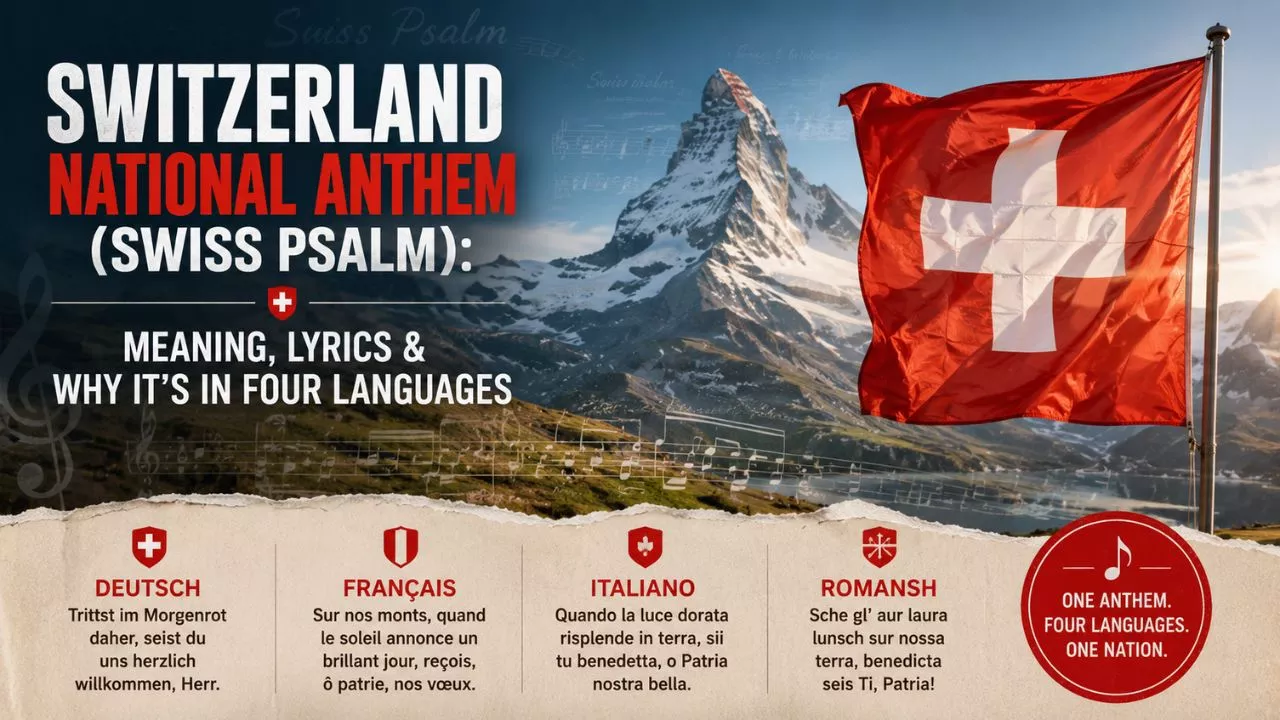
Switzerland does things its own way — including its anthem. The “Swiss Psalm” is sung in four national languages and reads more like a hymn than a battle cry. The Swiss face Canada on June 24. Here’s the story.
| Anthem | Swiss Psalm (Schweizerpsalm / Cantique suisse) |
| Music | Alberik Zwyssig (1841) |
| Lyrics | Leonhard Widmer |
| Officially adopted | 1981 |
| Languages | German, French, Italian & Romansh |
A Hymn, Not a War Song
The “Swiss Psalm” was composed by Alberik Zwyssig, a Cistercian monk, in 1841, with words by Leonhard Widmer. Its origins as a religious hymn give it a calm, reverent tone — it describes Switzerland’s Alpine dawn, sunsets and storms as glimpses of the divine.
Interestingly, it only became the official national anthem in 1981, after decades of provisional status.
Four Languages, One Country
Switzerland has four national languages — German, French, Italian and Romansh — and the Swiss Psalm has official versions in all of them. Players and fans sing in whichever is theirs, a neat reflection of the country’s multilingual identity.
A Debated Anthem
Not everyone loves it: there have been public campaigns to modernize or replace the Swiss Psalm, including a 2014 contest that proposed new lyrics — though the original has so far endured. Full background on Wikipedia.
More World Cup 2026 Music
More World Cup 2026 anthems & music: Mexico · Brazil · Japan. See also the multilingual Canada (O Canada) anthem they face on June 24. See also our history of World Cup anthems and who sings the official 2026 song.
A Quietly Consistent Force
Switzerland rarely grab headlines, but they’re one of international football’s most reliably competitive sides, regularly reaching the knockout rounds and upsetting bigger names along the way. Their understated efficiency mirrors the calm, hymn-like tone of their anthem.
The four-language Swiss Psalm also captures something essential about the country itself: many cultures, many languages, one team. When they line up against multilingual Canada on June 24, it’s a fittingly cosmopolitan matchup.
For neutrals, the Swiss Psalm is also a reminder that not every anthem is a rousing call to arms — some, like this one, sit closer to a quiet prayer. That contrast is part of what makes hearing all 48 anthems at a World Cup so fascinating: from Croatia’s gentle ode to Senegal’s call for koras and balafons, each one tells you something about the nation behind the shirt.
Frequently Asked Questions
What is Switzerland’s national anthem called?
The “Swiss Psalm” (Schweizerpsalm), composed by Alberik Zwyssig in 1841 with lyrics by Leonhard Widmer.
Why is the Swiss anthem in four languages?
Switzerland has four national languages — German, French, Italian and Romansh — and the anthem has an official version in each.
When did it become official?
Although written in 1841, the Swiss Psalm only became the official national anthem in 1981.
When does Switzerland play at the 2026 World Cup?
In this schedule, Switzerland face Canada on June 24 in the group stage.