
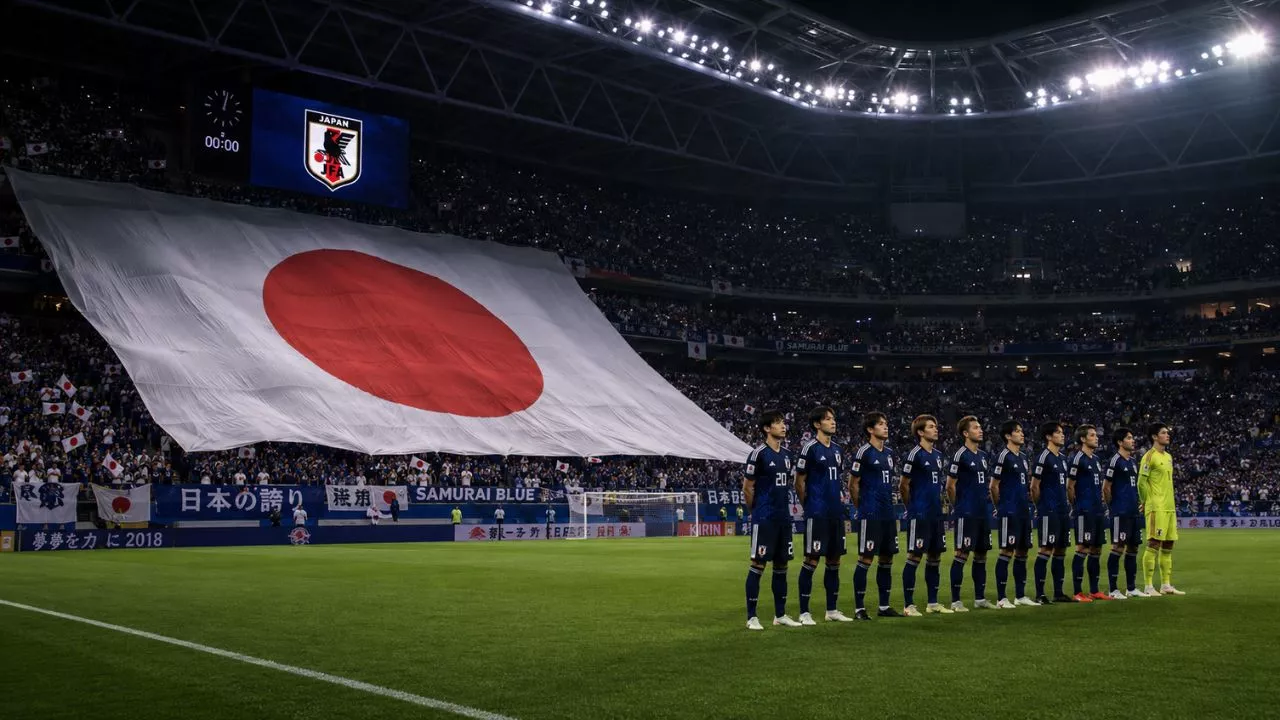
When Japan’s Samurai Blue line up against the Netherlands on June 14 in Dallas, their anthem will be over almost before it begins. “Kimigayo” is one of the shortest national anthems on Earth — yet it has the oldest lyrics of any anthem anywhere. Quite the combination.
| Anthem | Kimigayo (君が代) |
| Lyrics | From a 10th-century waka poem |
| Music | Oku & Hayashi, harmonized by Franz Eckert (1880) |
| Officially Adopted | 1999 |
| Length | ~11 bars (one of the shortest) |
| Language | Japanese |
The Shortest Anthem, the Oldest Words
“Kimigayo” is just four lines and around 32 characters long — you can sing the whole thing in under a minute. Yet its words come from a waka poem written in the Heian period (10th century), making them the oldest lyrics of any national anthem in the world. The melody was set in 1880 and it was only formally adopted as the official anthem in 1999.
What Kimigayo Means
The anthem is a wish for longevity and continuity. It expresses the hope that the reign “may continue for a thousand, eight thousand generations, until the pebbles grow into boulders covered in moss” — a beautiful image of endurance.
Why It Sounds So Different
Its melody draws on traditional Japanese gagaku court-music scales, giving it a modal, haunting quality unlike the march-style anthems of Europe. Full background is on Wikipedia.
More World Cup 2026 Anthems & Music
More World Cup 2026 national anthems: Mexico · USA · Canada · Brazil. See also our history of every World Cup anthem (1962–2026) and who sings the official World Cup 2026 song.
Japan’s Samurai Blue and Their Fans
Japan’s Samurai Blue have become one of the most respected teams in world football, famous for upsetting giants — and their supporters are equally beloved for tidying up the stadium after matches. Their tournament opens against the Netherlands on June 14 in Dallas.
Against the backdrop of all that energy, “Kimigayo” stands out for its calm. It is short, solemn and over quickly, a brief moment of stillness before the noise. For many neutral viewers it is one of the most distinctive anthems of the whole tournament precisely because it refuses to shout.
Japanese football has earned serious respect on the world stage. At the 2022 World Cup the Samurai Blue stunned both Germany and Spain in the group stage, and they have reached the knockout rounds multiple times — so “Kimigayo” is increasingly the sound of a genuine contender, not an underdog.
Its brevity is part of its power. While other nations stretch their anthems into grand productions, Japan’s is over in well under a minute, leaving a pocket of calm before kickoff that feels distinctly its own.
Frequently Asked Questions
What is Japan’s national anthem called?
It’s “Kimigayo,” whose lyrics come from a 10th-century Japanese waka poem — the oldest lyrics of any national anthem.
Why is Kimigayo so short?
At around 11 bars and four lines, it is one of the shortest national anthems in the world.
What does Kimigayo mean?
It is a wish for a long, enduring reign, using the image of pebbles growing into moss-covered boulders over time.
When was Kimigayo officially adopted?
Although its lyrics are centuries old and the music dates to 1880, it was formally adopted as Japan’s national anthem in 1999.