
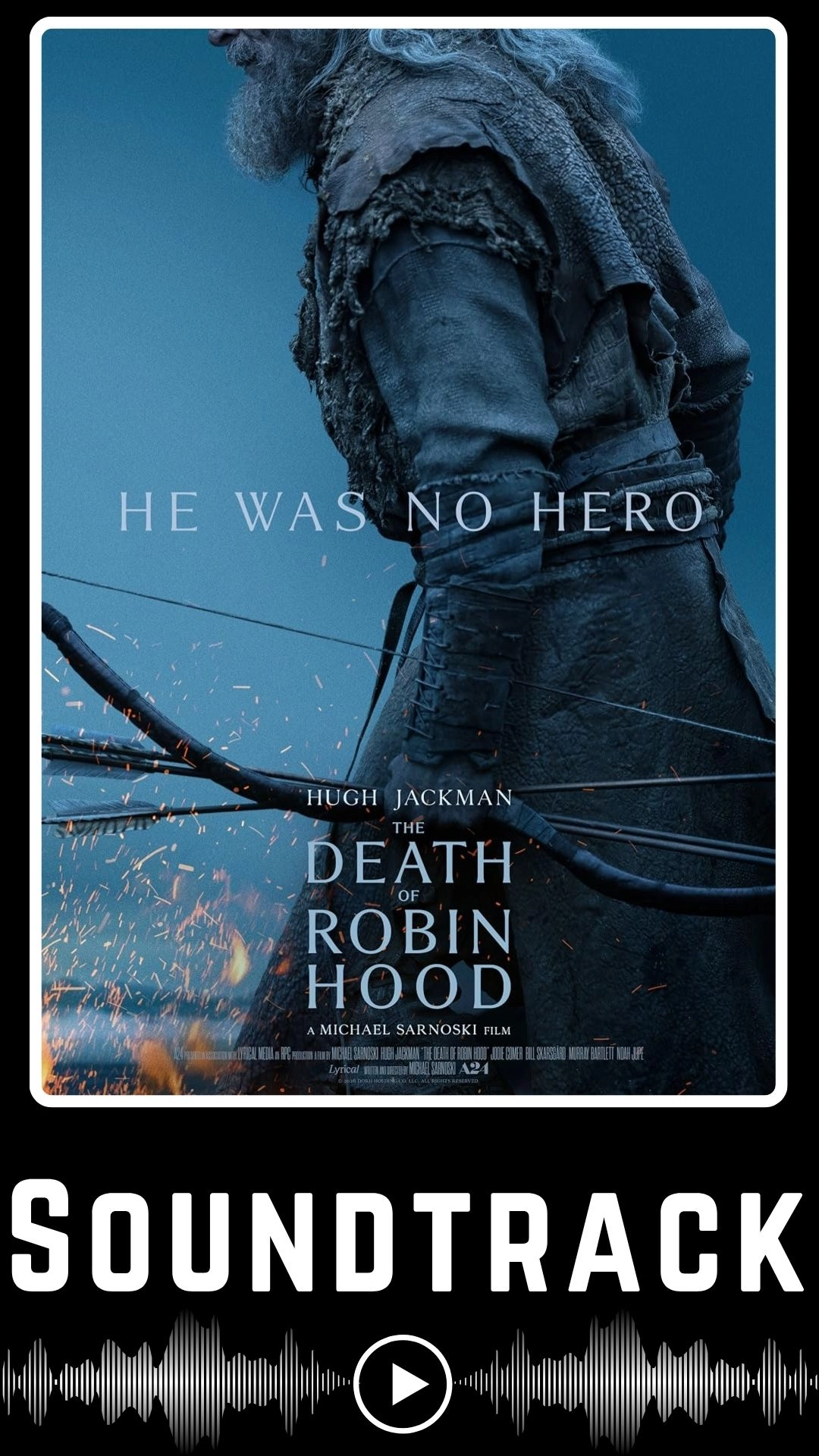
The Death of Robin Hood strips the legend of its romance and replaces it with mud, guilt, and moral reckoning. The A24 thriller, directed by Michael Sarnoski and starring Hugh Jackman, Jodie Comer, Bill Skarsgård, Murray Bartlett, and Noah Jupe, hit theaters nationwide on June 19, 2026 — and its music was always going to be anything but conventional. For the film’s score, Sarnoski turned not to an established Hollywood composer but to Jim Ghedi, a Sheffield-born folk singer and guitarist who had never scored a feature film before. The result is a 14-track album released the same day as the film under the A24 Music imprint — a work that critics have already called “darkly visceral and elegiac,” fully capable of standing on its own as a listening experience.
Soundtrack Details
| Detail | Info |
|---|---|
| Film | The Death of Robin Hood |
| Director | Michael Sarnoski |
| Production Companies | Lyrical Media, Ryder Picture Company (RPC) |
| Distributor | A24 |
| Theatrical Release Date | June 19, 2026 (USA) |
| World Premiere | 73rd Sydney Film Festival, June 12, 2026 |
| Composer | Jim Ghedi |
| Soundtrack Label | A24 Music |
| Soundtrack Release Date | June 19, 2026 |
| Total Tracks | 14 |
| Total Runtime | 48:06 |
| Format | Digital Album (Hi-Res) |
| UPC | 823375212867 |
The Death of Robin Hood Soundtrack Overview
The official soundtrack album for The Death of Robin Hood was released digitally on June 19, 2026, the same day the film opened in U.S. theaters. It is available on all major streaming and download platforms, including Apple Music, Spotify, and Amazon Music. The release is published under A24 Music, the in-house label of arthouse distributor A24, which has previously handled soundtrack releases for several of its productions.
The album contains 14 original tracks, all composed by Jim Ghedi, running to a total runtime of 48 minutes and 6 seconds. The score draws heavily from the British folk tradition — acoustic and electric guitars, atmospheric drones, and a spare, weathered sonic palette that mirrors the film’s unflinching depiction of 13th-century England. There are no orchestral sweeps or bombastic set-pieces. Instead, the music leans into unease, using texture and restraint to amplify the story’s themes of guilt and mortality. Reviewers have noted that the score feels “extremely evocative” and “deeply unromantic,” which is precisely the point — this is a Robin Hood story stripped of heroic myth, and the music follows suit.
Who Composed The Death of Robin Hood Soundtrack?
Jim Ghedi
The score for The Death of Robin Hood was composed by Jim Ghedi, a Sheffield-born folk singer, guitarist, and songwriter who marks his feature film scoring debut with this project.
Born in 1992 on the outskirts of Sheffield in South Yorkshire, England, Ghedi grew up in a working-class household and was raised by a single mother. He took up the guitar at age eight and spent his formative years moving through hip-hop and punk before a copy of Bert Jansch’s work — gifted to him by an aunt — redirected his creative path entirely. From that point, he immersed himself in British folk-rock (Pentangle, Steeleye Span), fingerstyle guitar tradition (John Fahey, John Renbourn), and traditional singers like the Watersons, eventually putting on folk nights at a DIY music space in Sheffield.
His debut album, Home Is Where I Exist, Now to Live and Die, was self-released in 2015 on Cambrian Records — an all-instrumental solo effort performed on fingerpicked six- and twelve-string acoustic guitars. He followed it with A Hymn for Ancient Land in 2018, which expanded his palette to include orchestral parts and traditional song alongside his fingerstyle compositions. His third solo album, In the Furrows of the Commonplace (2021), deepened his engagement with themes of environmental collapse and community memory.
It was his fourth solo album, Wasteland (2025, Basin Rock), that brought Ghedi to the attention of director Michael Sarnoski. The record — his most ambitious to that point — combined electric guitar, electric bass, synthesizers, and drums with his characteristic folk sensibility. Its apocalyptic tone and deeply English subject matter caught Sarnoski’s ear, and the director reached out to Ghedi almost immediately after discovering it. In Ghedi’s own account, Sarnoski messaged him on Instagram the very same moment Ghedi was joking to his mother about messaging the director first. Wasteland received widespread critical acclaim, with publications such as The Guardian, MOJO, and Uncut praising it as a landmark in contemporary British folk.
The Death of Robin Hood represents Ghedi’s first film score and his introduction to a significantly wider audience.
The Death of Robin Hood Official Tracklist
The following tracklist is confirmed via Film Music Reporter (primary source) and cross-referenced with FMDB, which also provides the total runtime of 48:06. Minor single-second discrepancies between the two sources are noted in the Source Transparency Report below.
| # | Track Title | Duration |
|---|---|---|
| 1 | Farm Attack | 3:11 |
| 2 | Bold Pedlar | 1:39 |
| 3 | Twa Corbies | 3:49 |
| 4 | Red Like the Setting Summer Sun | 0:57 |
| 5 | Lamentations of Round-Oak Waters | 5:53 |
| 6 | Elderfather Fight | 7:43 |
| 7 | Boat to the Priory | 1:50 |
| 8 | What Will Become of England | 4:17 |
| 9 | Walking Again | 4:46 |
| 10 | Sister Brigid’s Family | 3:24 |
| 11 | Making Arrows | 1:36 |
| 12 | Searching for Little Margaret | 2:32 |
| 13 | I Owe This Life to You | 3:09 |
| 14 | Robin’s Death | 3:20 |
Total Runtime: 48:06
Score Highlights
The album’s structure follows the film’s emotional arc — from brutal violence in the opening sequences through a slow, agonizing journey toward something resembling peace. Several tracks stand out as particular anchors for the score’s identity.
“Farm Attack” opens the album and the film with abrupt, unsettling immediacy. At just over three minutes, it likely sets the tone for the film’s famously brutal opening act, which critics have noted establishes within the first fifteen minutes that this is not a heroic Robin Hood. The track’s energy suggests disruption and urgency rather than adventure.
“Twa Corbies” carries a title drawn from a well-known traditional Scottish ballad about two crows discussing a dead knight — a piece long associated with mortality and the indifference of nature to human fate. At 3:49, it is likely one of the album’s more overtly folk-rooted moments, and its thematic resonance with the film’s subject matter is pointed: the legendary outlaw is, after all, dying.
“Lamentations of Round-Oak Waters” is the longest of the album’s quieter pieces at nearly six minutes. The title echoes the poetry of John Clare, the 18th-century Northamptonshire pastoral poet whose writing was closely tied to the natural landscapes of rural England. Given Ghedi’s established interest in the intersection of landscape, history, and loss, this track likely operates as a reflective passage — possibly associated with Robin’s internal reckoning rather than action.
“Elderfather Fight” is the score’s longest track at 7:43 and almost certainly the musical centerpiece of the film’s major action sequence involving Little John’s farm — a scene reviewers have described as one of the most viscerally brutal in recent memory. The duration suggests an extended, building piece rather than a short cue, which aligns with the complexity of that sequence as described in critical coverage.
“What Will Become of England” carries a title shared with a track from Ghedi’s Wasteland album — a traditional song about the decay of English society that became one of that record’s most celebrated pieces. Whether this is a re-orchestration of that material for the film or a new composition sharing only the title is unconfirmed from available sources. Its placement at track 8, after the film’s main violent confrontations, suggests it may accompany Robin’s recovery and moral contemplation at the priory.
“Robin’s Death” closes the album as its final track — a 3:20 piece whose function within the narrative is self-evident from its title. Given that the film is explicitly structured around the legend’s final hours, this track likely serves as an elegy rather than a dramatic flourish, consistent with the score’s overall restraint.
The Death of Robin Hood Licensed Songs / Needle Drops
Based on confirmed research across Tunefind, WhatSong, and SeekerTune, there are no verified licensed songs used as needle drops within The Death of Robin Hood. The film appears to rely entirely on Jim Ghedi’s original score.
Note on trailer music: Tunefind lists one song — “TUKI TUKI” by Kris R. and GeezyDee — attributed specifically to the film’s official trailer, not to the film itself. Per editorial standards, trailer-sourced music is not presented here as an in-film needle drop.
The absence of licensed tracks from Tunefind is treated as a confirmed null result for this article, not an indexing gap.
Jim Ghedi Composer Filmography
| Year | Title | Type | Role | Label |
|---|---|---|---|---|
| 2015 | Home Is Where I Exist, Now to Live and Die | Solo Album | Artist/Composer | Cambrian Records |
| 2018 | A Hymn for Ancient Land | Solo Album | Artist/Composer | — |
| 2021 | In the Furrows of the Commonplace | Solo Album | Artist/Composer | Basin Rock |
| 2023 | Jim Ghedi & Toby Hay (duo album) | Collaborative Album | Artist/Composer | — |
| 2025 | Wasteland | Solo Album | Artist/Composer | Basin Rock |
| 2026 | The Death of Robin Hood | Feature Film Score | Composer (debut) | A24 Music |
Note: Jim Ghedi has released additional collaborative work, including recordings with Cinder Well. The table above covers his primary solo and duo discography plus the film score, drawn from AllMusic, Last.fm, and official label sources.
Where to Listen to The Death of Robin Hood Soundtrack
The Death of Robin Hood Original Soundtrack is available to stream and download on all major digital platforms. You can listen on Spotify, Apple Music, and Amazon Music, where the full 14-track album is available in high-resolution digital format under A24 Music. For the film itself, The Death of Robin Hood was distributed theatrically in the U.S. by A24 from June 19, 2026; availability on streaming platforms will depend on A24’s future distribution arrangements, which had not been announced at the time of publication.
FAQs
Who composed the soundtrack for The Death of Robin Hood?
The score was composed by Jim Ghedi, a Sheffield-based folk singer-songwriter and guitarist. The Death of Robin Hood marks his feature film scoring debut. Director Michael Sarnoski discovered Ghedi through his 2025 album Wasteland and reached out directly to commission the score.
How many tracks are on The Death of Robin Hood soundtrack album?
The official soundtrack album contains 14 tracks with a total runtime of 48 minutes and 6 seconds.
When was The Death of Robin Hood soundtrack released? The soundtrack was released digitally on June 19, 2026 — the same date as the film’s U.S. theatrical release. It was published under the A24 Music label.
Where can I stream The Death of Robin Hood score?
The album is available on Spotify, Apple Music, and Amazon Music, among other major digital platforms. It was released as a high-resolution digital album.
Are there any licensed songs in The Death of Robin Hood?
No licensed songs or needle drops have been confirmed within the film itself. The soundtrack relies entirely on Jim Ghedi’s original score. A song listed on Tunefind — “TUKI TUKI” by Kris R. and GeezyDee — is attributed to the official trailer only, not the film.
What is the tone of The Death of Robin Hood score?
Critics have described the score as “darkly visceral and elegiac,” rooted in British folk tradition. Ghedi draws on acoustic and electric guitar, atmospheric drones, and a spare, restrained sound that reflects the film’s bleak and unflinching tone — reviewers have compared the overall sonic mood to that of a dirge.
What is Jim Ghedi known for before this film?
Prior to scoring The Death of Robin Hood, Jim Ghedi was known primarily as a respected figure in British experimental folk music. His 2025 album Wasteland — released on Basin Rock — received widespread critical acclaim from outlets including MOJO, Uncut, and The Guardian, and was widely regarded as his breakthrough record.