
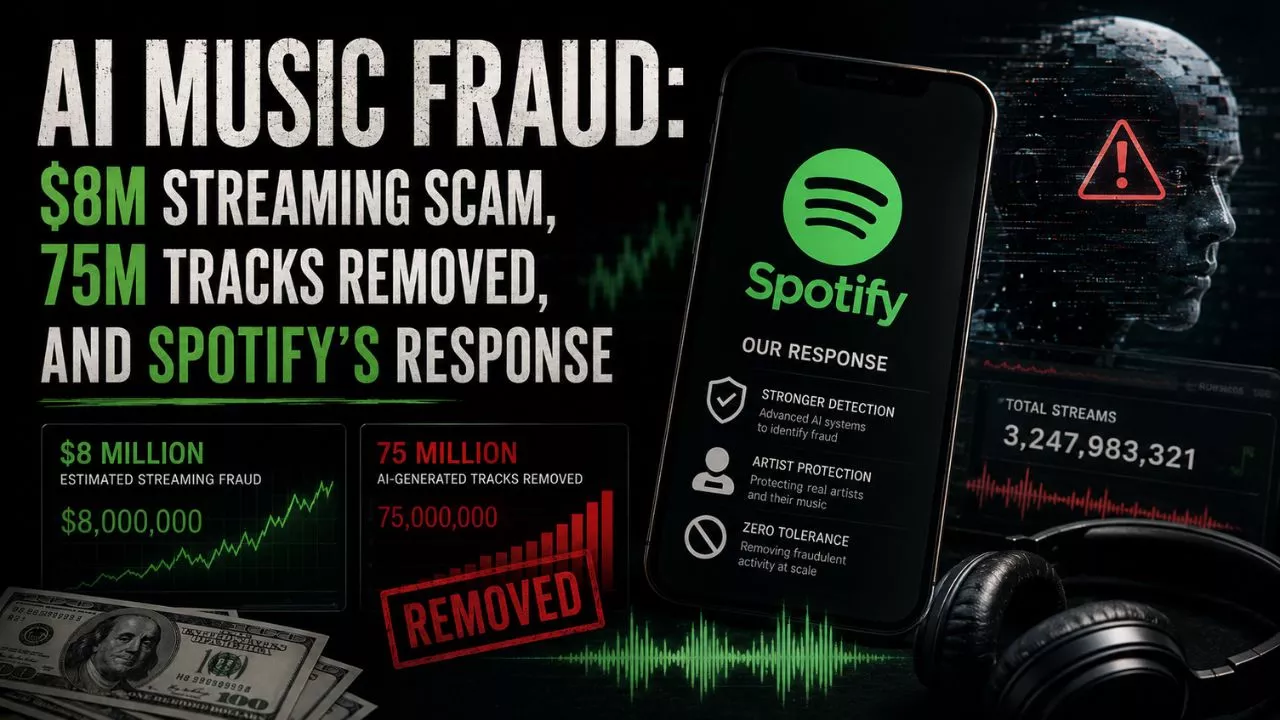
The most surreal story in music in the first half of 2026 is also the most quietly horrifying. A North Carolina man pleaded guilty to a federal fraud case involving over $8 million in streaming royalties — collected by uploading hundreds of thousands of AI-generated tracks to Apple Music, Amazon Music, and Spotify and then using bot networks to stream them billions of times. The case has become the cleanest single illustration of the AI-music problem that has been building on every major streaming platform for two years.
I have been writing about streaming royalties since 2021 and the math on this scam still keeps me up at night. So here is the whole picture: how the fraud worked, how the platforms are responding, the new policies that are about to land, and what any working artist or composer should actually do about it.
The Scam, in One Diagram
| Step | What Happened |
|---|---|
| 1 | Used AI generators to produce hundreds of thousands of short instrumental tracks |
| 2 | Uploaded them to Spotify, Apple Music, Amazon Music via standard music-distribution services |
| 3 | Spun up bot networks (automated "listeners") on cloud infrastructure |
| 4 | Bots streamed each AI track billions of times across the platforms |
| 5 | Streaming services paid out royalties on what looked like a successful catalog |
| 6 | Operator collected more than $8 million before being caught |
The terrifying part is not the scale of the fraud. It is that every step in that chain is technically permitted by current platform policies if you are clever about your detection-evasion. The bot networks rotate IP addresses, vary their session lengths, and play tracks in different orders to avoid pattern matching. The AI generators produce enough audio variation that no two tracks fingerprint identically. And once those streams are counted, the royalty math is the royalty math.
Why This Hurts Working Musicians
Streaming royalty pools are zero-sum. Spotify and similar platforms pay out a fixed share of their subscription revenue as royalties — the “pro-rata” model. If fake AI streams take a slice of that pool, every actual working artist’s per-stream payout shrinks. That is the bit that everyone covering this story keeps coming back to: every dollar paid to AI-music fraud is a dollar that did not go to a real composer, songwriter, or performer.
The current per-1,000-stream payout averages are roughly $3–$5 on Spotify and $7–$10 on Apple Music. Those numbers have been falling year-over-year for over a decade. AI-music fraud is one of three pressures (the others being subscription pricing inertia and a global increase in tracks uploaded) pushing those numbers downward.
How the Platforms Are Responding
Spotify reports having removed 75 million tracks identified as spam, fraud, or low-quality AI output within a single year. In September 2025 Spotify announced beefed-up AI protections for artists, songwriters, and producers. Apple Music introduced an internal classifier that flags suspected bot-streamed catalog and reduces or freezes payouts on accounts flagged for fraud patterns. Sony Music alone purged 135,000 AI deepfakes from various platforms in March 2026. Spotify’s AI disclosure beta — launched April 16, 2026 — lets artists declare exactly how AI was used in their music (vocals, lyrics, production), with that information surfaced in Song Credits on mobile.
What “Streaming Slop” Looks Like in the Wild
If you have ever opened a generic Spotify playlist — “Lo-Fi Beats for Studying,” “Background Piano,” “Sleep Sounds” — and felt that the artist names were oddly anonymous and the music oddly samey, you have probably encountered the legal-grey version of this same problem. AI-generated functional music is now a major share of what fills these algorithmic background playlists. Most of it is not technically fraud, because the streams are real. But it is squeezing real composers out of those royalty pools.
The new wave of AI-disclosure tools is mostly aimed at making it easier for listeners to tell the difference, which is the right starting move. But the bigger question is whether streaming platforms will move to a user-centric royalty model — where your subscription dollars only pay the artists you actually listen to — which would structurally cut off most of this fraud. Tidal moved partly in that direction in 2023. Spotify and Apple have not yet committed.
What Working Artists Should Actually Do
Use the AI disclosure beta if you are on Spotify. Transparent declarations build listener trust and may eventually be a ranking signal. Monitor your back catalog for AI imitations. Search your name on Spotify and Apple Music monthly. Several fraud rings now upload AI tracks under variations of established artist names to siphon search traffic. Document your creative process. Save session files, stems, voice memos, anything that establishes you as the human author. If a takedown dispute arises, this is what wins it. Use distribution services with proactive fraud detection. DistroKid, CD Baby, and TuneCore have all expanded their content-moderation teams; smaller distributors typically have not.
Frequently Asked Questions
How did the $8 million AI music fraud work?
A North Carolina man used AI music generators to produce hundreds of thousands of tracks, uploaded them to Spotify, Apple Music, and Amazon Music, and then used automated bot networks to stream them billions of times. The platforms paid royalties on those streams. He collected over $8 million in fraudulent royalties before being caught and pleaded guilty in 2026.
How many AI tracks has Spotify removed?
Spotify reports having removed approximately 75 million spammy or fraudulent tracks in the year leading up to the 2026 report. Sony Music separately purged 135,000 AI deepfakes from various platforms in March 2026.
Does AI music fraud actually affect real musicians’ royalties?
Yes. Streaming royalties operate on a pro-rata model — every play takes a share from a fixed pool. Each fake stream paid to AI music reduces the per-stream payout to real artists. It is one of the main factors driving year-over-year declines in per-stream rates.
What is Spotify’s new AI disclosure feature?
Launched in beta on April 16, 2026, the feature lets artists disclose exactly how AI was used in their tracks — for vocals, lyrics, production, or other contributions. The disclosure is shown in Song Credits on the Spotify mobile app, giving listeners transparency about AI involvement.
How much do streaming services actually pay per stream?
As of 2026, 1,000 streams pay roughly $3–$5 on Spotify and $7–$10 on Apple Music. Apple Music typically pays 1.5 to 2 times more per stream than Spotify. Rates vary by listener subscription tier and country.
For more music industry coverage, check our soundtrack news section.