
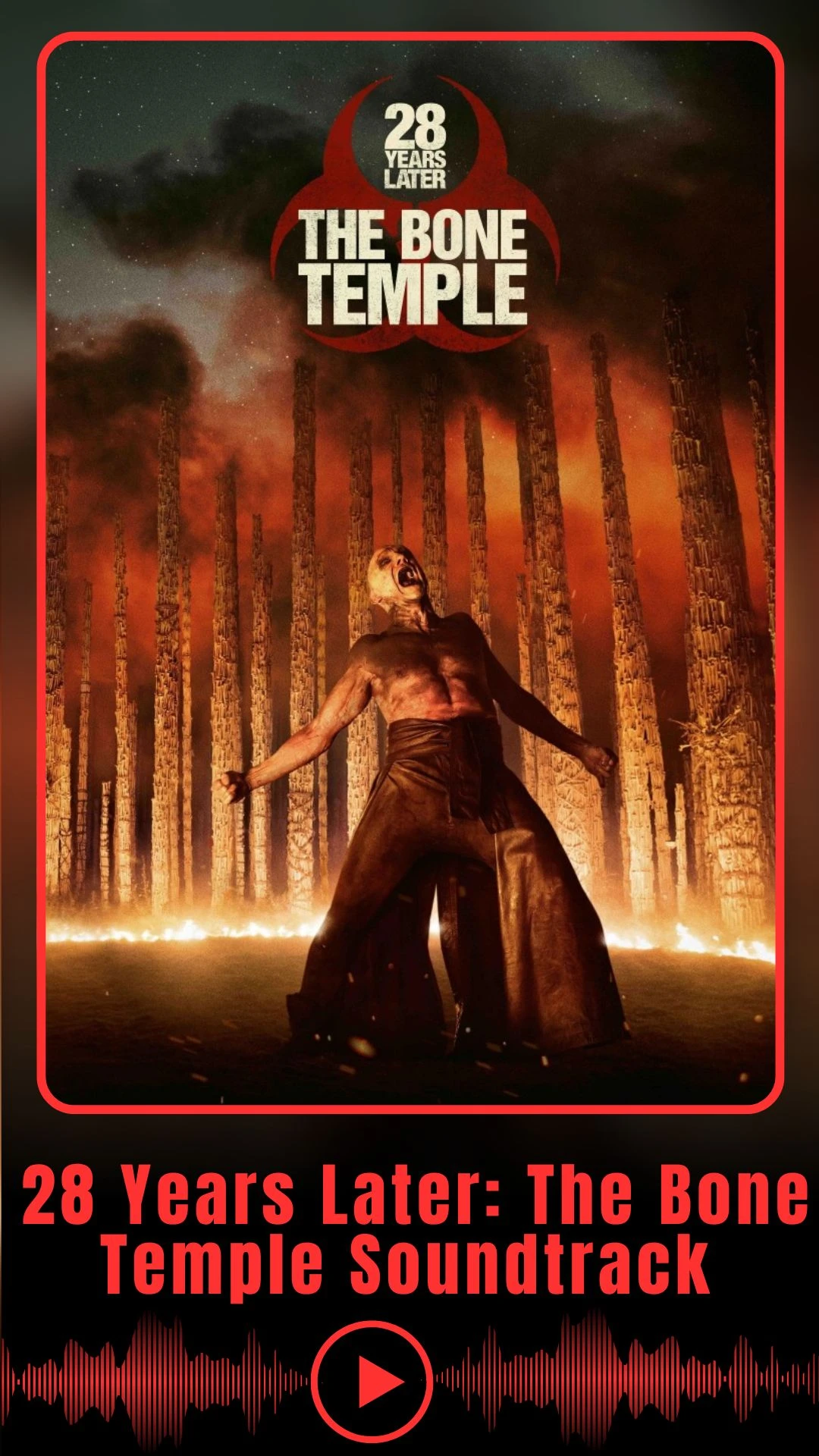
The 2026 horror sequel 28 Years Later: The Bone Temple expands the dark legacy of the 28 Days Later universe not only through its disturbing story but also with a powerful and unsettling soundtrack. Directed by Nia DaCosta and written by Alex Garland, the film’s music plays a major role in shaping its bleak, ritualistic atmosphere.
Unlike earlier films in the franchise, The Bone Temple takes a bold new musical direction, blending an operatic orchestral score with carefully chosen classic songs that create an eerie contrast between civilization and collapse.
Who Composed the Soundtrack of 28 Years Later: The Bone Temple?
The original score for 28 Years Later: The Bone Temple is composed by Hildur Guðnadóttir, the Academy Award–winning composer known for Joker and Chernobyl. Her involvement marks a major shift for the franchise.
Instead of aggressive or industrial sounds, Guðnadóttir delivers a haunting, atmospheric orchestral score. The music feels slow, mournful, and almost ceremonial, reflecting themes of ritual, decay, and lost humanity that define the Bone Temple itself.
Critics have described the score as hypnotic and ethereal, using long drones, low strings, and choral textures to create constant unease rather than sudden shock.
A Special Musical Surprise in the End Credits
While Hildur Guðnadóttir leads most of the score, the end credits music brings back John Murphy, the original composer of 28 Days Later. This final cue is noticeably more upbeat and ironic, offering a strange emotional contrast after the film’s heavy ending and subtly reconnecting the sequel to the original trilogy roots.
28 Years Later: The Bone Temple Soundtrack Official Score Tracklist
The official score album was released on January 16, 2026, alongside the film’s theatrical release. Key tracks include:
- Bare Bones
- Pool Fight
- Building Temple
- Really Old Nick
- Moon
- Obey Me
- The Bone Temple
These tracks focus more on mood than melody, allowing tension to slowly build rather than explode.
Songs Featured in the Movie (Needle Drops)
In addition to the original score, 28 Years Later: The Bone Temple uses several well-known songs within the story, mostly tied to Dr. Kelson’s sanctuary. These moments feel unsettling because they introduce familiar music into a brutal world.
Notable songs include:
- Everything In Its Right Place – Radiohead
Used during a key scene involving Dr. Kelson and the infected Samson. - Ordinary World and Girls on Film – Duran Duran
Played inside the Bone Temple, symbolizing a fragile sense of normalcy. - The Number of the Beast – Iron Maiden
A shocking, high-energy moment used during a violent mainland confrontation.
These songs sharply contrast with the orchestral score, making the world feel even more distorted.
How the Music Fits in 28 Years Later: The Bone Temple Soundtrack Story
Music in 28 Years Later: The Bone Temple is not just background sound. It reflects the psychological state of its characters, especially Dr. Kelson, and highlights the clash between ritualized survival and lost civilization. The slow orchestral score emphasizes dread and inevitability, while the needle-drop songs remind viewers of what the world used to be.
FAQs
Who composed the soundtrack for 28 Years Later: The Bone Temple?
The original score was composed by Hildur Guðnadóttir.
Is John Murphy involved in the movie’s music?
Yes. John Murphy returns for the end credits track, linking the film musically to the original 28 Days Later.
Are there songs featured in the movie besides the score?
Yes. The film includes songs by Radiohead, Duran Duran, and Iron Maiden.
Where can you listen to the 28 Years Later: The Bone Temple soundtrack?
The official score album is available on major music streaming platforms, including Spotify and Apple Music.
When was the soundtrack released?
The soundtrack was released on January 16, 2026, the same day as the film’s theatrical release, by Columbia Pictures.
Does the soundtrack match the earlier 28 Days Later films?
Musically, it is very different. The Bone Temple uses a more orchestral and tragic sound, instead of the aggressive, raw style of earlier films.
The soundtrack of 28 Years Later: The Bone Temple is one of the film’s strongest elements. By combining Hildur Guðnadóttir’s haunting orchestral score with unexpected classic songs, the movie creates an unforgettable audio experience that deepens its themes of fear, ritual, and survival. For fans of atmospheric horror music, this soundtrack stands out as one of 2026’s most distinctive film scores.