
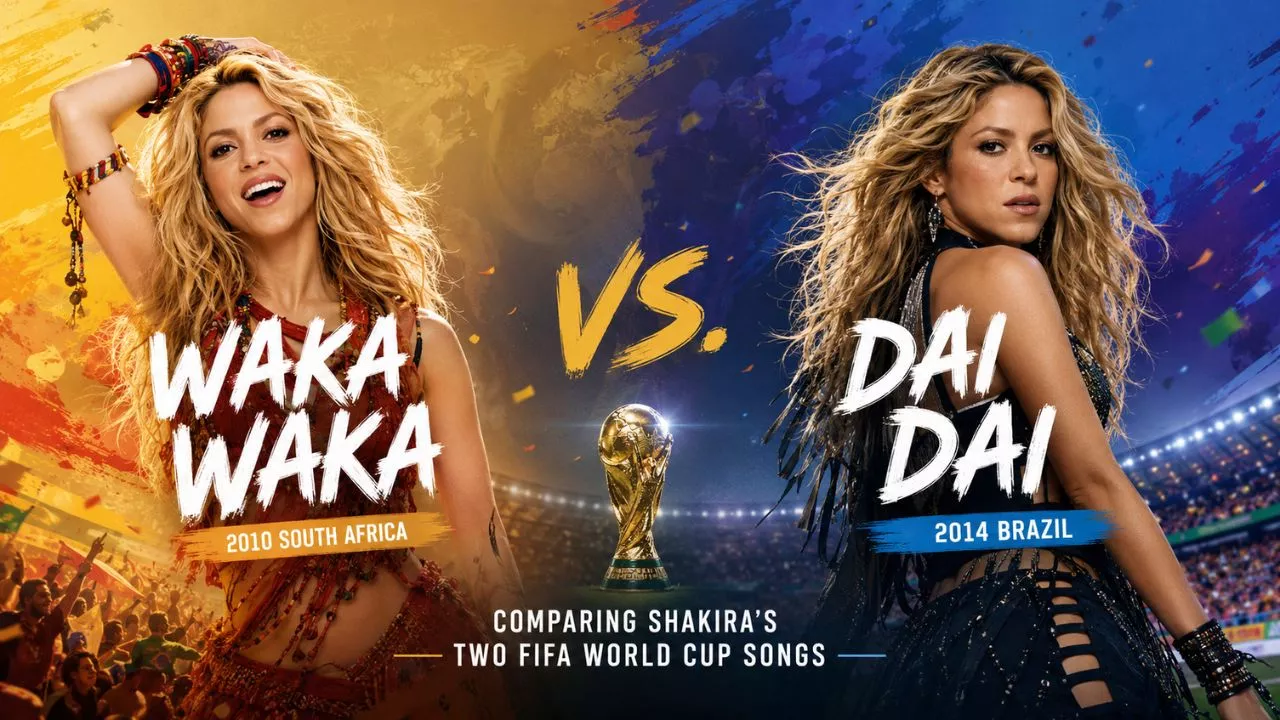
Sixteen years apart. Two completely different tournaments. Two completely different songs. And yet, the same artist at the center of both.
Shakira is the only musician in FIFA World Cup history to write and perform the official tournament song more than once — first with “Waka Waka (This Time for Africa)” in 2010 and now with “Dai Dai” (featuring Burna Boy) for 2026. That fact alone makes a side-by-side comparison almost inevitable.
But this isn’t just a nostalgia exercise. How do the two songs actually hold up against each other? Same artist, same tournament, very different eras of music — and very different contexts for what a World Cup anthem is supposed to do.
Here’s the full breakdown.
The Origin Stories: How Each Song Came to Be
“Waka Waka” didn’t come from a boardroom strategy session. According to Shakira, she was walking from a barn into a house on her farm in Uruguay when the verse melody and lyrics came to her instinctively in English. Her label, Sony Music, had approached her about recording a song for the 2010 South Africa World Cup, and the result was a track that fused genres, languages, and beats from multiple continents in a way nobody had quite heard before.
The song’s DNA runs even deeper than most fans realize. “Waka Waka” built its iconic chorus by sampling “Zamina mina (Zangaléwa)” — a 1986 Cameroonian makossa track by the group Golden Sounds, originally formed by members of Cameroon’s presidential guard. The chant “Tsamina mina zangalewa” roughly translates to “Where do you come from?” — a phrase used by Cameroonian soldiers on long marches to keep morale alive. What began as a military marching rhythm from World War II-era Central Africa eventually became the heartbeat of the most-streamed World Cup song in history. Golden Sounds were later credited as co-writers and reached an out-of-court agreement with Sony and Shakira’s team over rights and royalties.
“Dai Dai” has a very different creative fingerprint. Released on May 15, 2026, the track was produced by Shakira herself alongside Alexander Castillo, with songwriting credits going to a surprising team: Shakira, Burna Boy, Ed Sheeran, Jon Bellion, Benny Adam, and Castillo. The title is borrowed from Italian — “dai dai” means “come on, come on” — a cheer, an encouragement, a push toward the finish line. It was designed from the ground up as a five-language track (English, Spanish, Italian, French, and Japanese) to match the 2026 tournament’s unprecedented scope as the first World Cup co-hosted by three nations: the United States, Mexico, and Canada.
The Sound: Old Energy vs. New Architecture
This is where the two songs feel most different from each other.
“Waka Waka” is unmistakably rooted in Afropop and soca, with that military-march rhythm underneath. The tempo is fast, the energy is physical, and the chorus is designed to be shouted back at full volume by a crowd of 90,000 people. It’s a song built for movement — and it delivered. Researchers at SeatPick later gave it an 8.4 out of 10 on a combined scale measuring danceability, energy, and positivity, crowning it the catchiest soccer song ever recorded.
“Dai Dai” operates differently. Where “Waka Waka” grabs you in the first eight seconds of that chorus, “Dai Dai” builds across its 3 minutes and 43 seconds through a blend of Afrobeats (Burna Boy’s lane) and Latin pop (Shakira’s). It’s a more globally distributed sound — less of a single, unified genre explosion and more of a deliberate meeting point between two of the biggest music movements on the planet right now. Critics have noted it doesn’t have the immediate floor-filling impact of “Waka Waka,” but it maps more accurately onto what global streaming audiences are actually listening to in 2026.
Think of it this way: “Waka Waka” was a bolt of lightning that nobody saw coming. “Dai Dai” is a precision instrument — engineered for a wider cultural brief.
The Numbers: Legacy vs. A Song Still Being Written
This is the one category where there’s no contest — yet.
“Waka Waka” is, by every measurable standard, the biggest World Cup song ever recorded. As of January 2025, it had registered over 1.074 billion streams on Spotify across all versions — earning it the Guinness World Record for most-streamed FIFA World Cup song on the platform. Its music video has been viewed 4.4 billion times on YouTube, making it the eighth most-watched music video of all time on the platform. The song topped charts in 15 countries and sold over 15 million downloads worldwide. It peaked at No. 2 on the Billboard Hot Latin Songs chart and No. 38 on the Billboard Hot 100.
And it keeps coming back. At the 2022 Qatar World Cup, “Waka Waka” re-entered the Billboard Global 200 chart — twelve years after its release — simply because fans instinctively reached for it every time football season arrived.
“Dai Dai” has around 51 million Spotify streams at the time of writing — but the tournament only just kicked off. The song’s real numbers will be written over the next five weeks, as billions of viewers worldwide hear it attached to every major tournament moment. Its live debut came on June 11, 2026, at the Estadio Azteca in Mexico City, where Shakira performed in a bright yellow mesh bodysuit alongside Burna Boy in front of a packed stadium and a global broadcast audience. Royalties from the song also support the FIFA Global Citizen Education Fund, which is aiming to raise $100 million for children’s education programs worldwide.
The comparison right now is inherently unfair — “Waka Waka” had 16 years to become a monument. “Dai Dai” is still in its first chapter.
The Featured Artists: A Continent Apart
Who Shakira shared the mic with in each song tells you a lot about what FIFA was trying to achieve in each era.
“Waka Waka” features Freshlyground, a South African Afro-fusion band. That choice was deliberate — the 2010 tournament was held in South Africa, and having a local band co-headline the official song rooted it in the host continent in a way that felt genuine rather than cosmetic. Freshlyground’s presence gave “Waka Waka” an authenticity that made the Africa-first messaging land.
“Dai Dai” features Burna Boy — a Nigerian-born Afrobeats superstar who became the first solo Nigerian artist to win a Grammy Award (for best global music album, in 2021) and the first African artist to sell out a US stadium (New York’s Citi Field in 2023). Pairing Shakira’s Latin pop authority with Burna Boy’s Afrobeats dominance gives “Dai Dai” a Latin-Africa axis that reflects where global music streaming weight actually sits in 2026. It’s a bigger artist partnership, built for a bigger, more fragmented audience.
What Each Song Was Really About
The lyrics of both songs are nominally about football, but each one carries a slightly different emotional charge.
“Waka Waka” is a battle cry. It borrows the spirit of those Cameroonian soldiers urging each other forward — do it, you can do it — and redirects it at athletes on a pitch. The message is about individual grit, rising from struggle, and proving yourself on the biggest stage. It hits like a pre-match locker room speech set to music.
“Dai Dai” is an invitation. “Come on, come on” — it’s not a war chant, it’s a pull toward something shared. The five-language design reflects the 2026 tournament’s brief of reaching 48 teams from six confederations across a genuinely unprecedented global footprint. Where “Waka Waka” rallied individuals to perform, “Dai Dai” asks a crowd of billions to come together.
Different moods, both valid — and both unmistakably Shakira.
The Verdict: Nostalgia vs. Now
Here’s the honest answer: “Waka Waka” is the greater song. Sixteen years of data don’t lie, and a Guinness World Record plus 4.4 billion YouTube views is not something “Dai Dai” is going to catch in the next five weeks.
But that’s not really the right question. “Waka Waka” wasn’t built to be beaten. It was a once-in-a-generation collision of the right artist, the right tournament, the right sample, and the right moment in global pop music. Even Shakira couldn’t replicate it on purpose.
What “Dai Dai” is doing is something different and arguably harder: it’s trying to be the right song for 2026 — a tournament bigger, broader, and more fragmented than any before it. Whether it earns that place in the cultural memory of this tournament is a question the next five weeks will answer.
One thing is already certain: Shakira is the only artist in World Cup history whose music defines two completely different eras of the tournament. That’s a legacy “Waka Waka” built, and “Dai Dai” is now extending.
For more on “Dai Dai,” check out our full breakdown of who sings the official World Cup 2026 song, and our guide to Shakira’s role in the World Cup 2026 Final Halftime Show.
Want to see how both songs fit into the bigger picture of FIFA’s music history? Our complete Official FIFA World Cup 2026 Album tracklist guide covers every track in the 2026 lineup.
FAQs
Is “Dai Dai” the same as “Waka Waka”?
No. Both are Shakira’s official FIFA World Cup songs — “Waka Waka” for the 2010 tournament in South Africa, and “Dai Dai” for the 2026 tournament co-hosted by the United States, Mexico, and Canada. They are completely different songs with different featured artists, genres, and meanings.
What does “Waka Waka” mean?
“Waka Waka” comes from the Fang language, spoken in Cameroon and surrounding countries. It loosely translates to “do it” — a motivational call to action. The chorus samples a 1986 Cameroonian makossa track called “Zangaléwa” by Golden Sounds.
What does “Dai Dai” mean?
“Dai Dai” comes from Italian and means “come on, come on” — an encouraging cheer urging someone to give their best.
How many streams does “Waka Waka” have?
As of January 2025, “Waka Waka” had crossed 1.074 billion Spotify streams across all versions, earning the Guinness World Record for most-streamed FIFA World Cup song on the platform.
Who wrote “Dai Dai”?
Songwriting credits go to Shakira, Burna Boy, Ed Sheeran, Jon Bellion, Benny Adam, and Alexander Castillo. Shakira and Castillo produced the track.