
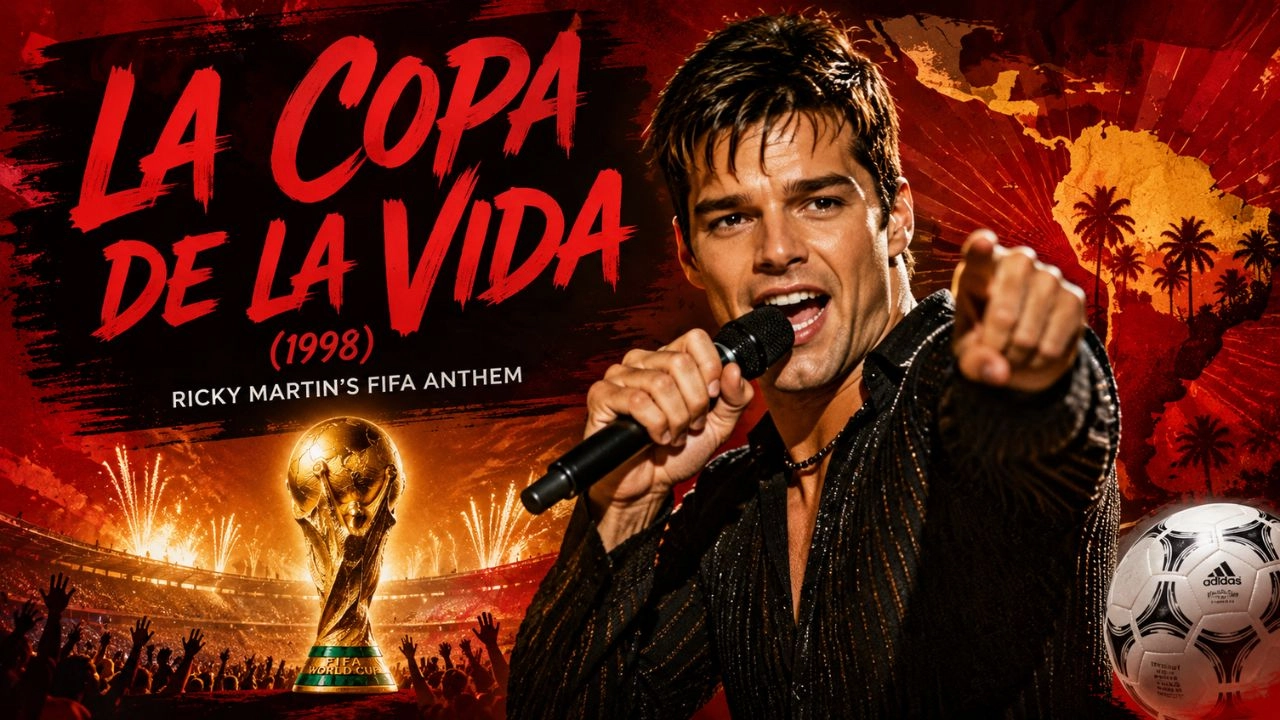
I have read every credible English-language history of late-90s pop music, and they all agree on one thing: the modern global Latin-pop boom started with a single song. Ricky Martin’s “La Copa de la Vida” (The Cup of Life) — the official FIFA World Cup 1998 anthem — was not just a successful tournament song. It was the moment Latin pop genuinely crossed into the global English-language mainstream and the song that turned Martin from a Puerto Rican regional star into one of the biggest names in pop.
Twenty-eight years after its release, this is still the song you cannot avoid in a deep history of World Cup music. Here is the full story.
“La Copa de la Vida” — The Headline Facts
| Item | Detail |
|---|---|
| Song title | "La Copa de la Vida" (Spanish) / "The Cup of Life" (English version) |
| Artist | Ricky Martin |
| Tournament | 1998 FIFA World Cup France |
| Album | Vuelve (1998) |
| Label | Sony Discos / Columbia |
| Composers | K. C. Porter, Robi Rosa, Désmónd Child |
| Performance | 1998 FIFA World Cup closing ceremony, Stade de France |
| Chart peaks | #1 in 30+ countries |
The Song That Started a Genre Boom
By the time France 1998 kicked off in June, Ricky Martin was already a major star in the Spanish-speaking world — veteran of the boy band Menúdo, two solo Spanish-language albums under his belt, including 1998’s Vuelve. What he was not, yet, was a household name in the United States.
“La Copa de la Vida” changed that overnight. Performed at the closing ceremony of the 1998 final at the Stade de France — the night Zinédine Zidane’s two headers gave France the trophy — the song reached a global television audience of over a billion viewers. Within weeks it was at No. 1 in more than 30 countries.
The bilingual structure of the song (Spanish and English vocal lines woven together in the same arrangement) was what made it travel. Martin performed it on the Grammy Awards in early 1999, becoming one of the first Latin-language artists to perform on the main Grammys stage in modern memory. Two months later, he released “Livin’ la Vida Loca,” and the late-90s Latin pop explosion was off and running.
The Songwriters and Producers Behind It
“La Copa de la Vida” was co-written by K. C. Porter, Robi Rosa, and Desmond Child. Each name on that credit matters:
- Desmond Child — one of the most successful pop-rock songwriters of all time, with credits on Bon Jovi’s “Livin’ on a Prayer” and Aerosmith’s “Dude (Looks Like a Lady)”
- K. C. Porter — the producer most responsible for translating Latin music into the English-language pop market in the 1990s; later worked extensively with Marc Anthony, Selena, Carlos Santana, and others
- Robi Rosa — like Martin, a Menúdo alumnus; one of the most influential Spanish-language producers of the 90s and 2000s
The combination meant the song had pop-songwriting craft, Latin-music production sensibility, and a vocalist already working in both languages. It was, in retrospect, an unbeatable combination for the moment.
The Closing Ceremony Performance That Made History
If you have not seen Ricky Martin’s 1998 World Cup closing ceremony performance, find it on YouTube. The clip is foundational. Stade de France full to the roof, France just having won their first World Cup, and a then-26-year-old Ricky Martin in a white silk shirt leading the entire stadium in “Allez! Allez! Allez!” The energy is enormous. The song was already a hit; this performance turned it into a permanent fixture of pop history.
Cultural Aftermath: The Latin Pop Boom
Within 18 months of the World Cup performance, “La Copa de la Vida” had directly contributed to:
- Ricky Martin’s self-titled English-language debut album, which sold 8+ million copies in the U.S.
- The mainstream U.S. emergence of Enrique Iglesias, Marc Anthony, and Jennifer Lopez as crossover pop artists
- The wider Latin Grammy movement (the inaugural Latin Grammy ceremony was held in 2000)
- The template for every “global pop star with a bilingual chorus” release since — from Shakira to J Balvin to Bad Bunny
That is a remarkable legacy for a song commissioned as a tournament theme.
Where to Listen to “La Copa de la Vida”
- Spotify — the Spanish original (“La Copa de la Vida”) and English version (“The Cup of Life”) are both available on Ricky Martin’s artist page
- Apple Music — both versions are on the Vuelve album
- Amazon Music — available to stream and purchase
- YouTube — the official music video has well over 100 million views; the 1998 closing-ceremony performance clip is on multiple official FIFA and broadcaster channels
- Vinyl reissues — Vuelve has had multiple vinyl pressings over the years
Frequently Asked Questions
What is “La Copa de la Vida”?
“La Copa de la Vida” (Spanish) — also known as “The Cup of Life” in its English version — is the official anthem of the 1998 FIFA World Cup in France, performed by Ricky Martin. It is from his Spanish-language album Vuelve.
Who wrote “La Copa de la Vida”?
The song was co-written by K. C. Porter, Robi Rosa, and Desmond Child. Child is one of the most decorated pop-rock songwriters in history (Bon Jovi, Aerosmith); Porter is a leading Latin music producer of the 90s; and Robi Rosa was a frequent Ricky Martin collaborator.
Where was “La Copa de la Vida” performed?
Ricky Martin performed “La Copa de la Vida” at the 1998 FIFA World Cup closing ceremony at the Stade de France, immediately preceding the final between France and Brazil on July 12, 1998. France won 3-0, with Zinédine Zidane scoring two headers.
How successful was the song?
“La Copa de la Vida” was a No. 1 hit in more than 30 countries and is widely credited with launching the late-90s Latin pop explosion. It directly led to Ricky Martin’s self-titled English-language album, “Livin’ la Vida Loca,” and his Grammy-stage debut in 1999.
Is “La Copa de la Vida” on Spotify and Apple Music?
Yes. Both the Spanish original and the English version (“The Cup of Life”) are available on Spotify, Apple Music, Amazon Music, YouTube Music, Tidal, and Deezer. They appear on Ricky Martin’s 1998 album Vuelve.
For more historical FIFA music coverage, see our soundtrack news section.