
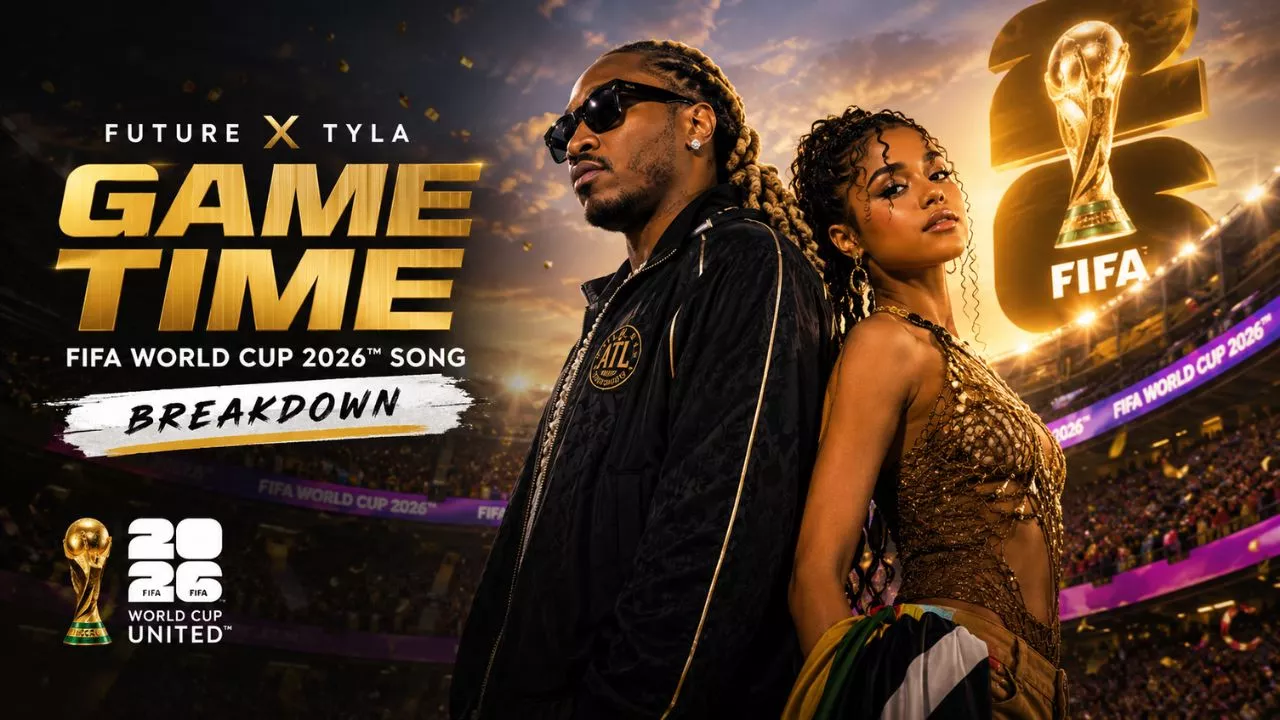
Nobody saw this pairing coming. When FIFA Sound began rolling out the Official FIFA World Cup 2026 Album earlier this year, the confirmed collaborations kept defying expectations — Latin meets country, K-pop meets Afrobeats, corridos meets East Atlanta trap. But the announcement of Future and Tyla on a single track stopped people mid-scroll.
An Atlanta rap heavyweight whose entire aesthetic is built on dark, smoke-filled, low-lit trap music. And a South African popiano queen whose rise was defined by effortless, sun-drenched global pop. On paper, it reads like a mismatch. On playback, it’s one of the most interesting things on the entire album.
Here is the full breakdown of “Game Time” — what it is, who made it, what it sounds like, and why it actually makes sense.
What Is “Game Time”?
“Game Time” is a collaborative single by American rapper Future and South African singer-songwriter Tyla, released on May 29, 2026, as the seventh single from the Official FIFA World Cup 2026™ Album under FIFA Sound, distributed via SALXCO UAM and Def Jam Recordings. The track runs 3 minutes and 27 seconds and blends hip-hop and Afrobeats with bold brass arrangements and stadium-scale percussion.
It was produced by Cirkut — a Grammy Award-winning hitmaker whose production credits span Katy Perry’s “Roar,” The Weeknd’s “Can’t Feel My Face,” and Miley Cyrus’s “Wrecking Ball” — giving “Game Time” a mainstream pop production backbone underneath its genre-blending surface.
The song is available now on all major streaming platforms. Stream it directly on Spotify or watch the official music video on YouTube.
The Artists: Who Is Future?
Future — born Nayvadius DeMun Cash in Atlanta, Georgia — is one of the most commercially dominant and critically influential figures in American hip-hop of the past 15 years. He is widely credited with pioneering melodic trap, the now-ubiquitous style that blends sung melodies with rap cadence over dark, distorted 808 production.
His discography includes a string of Billboard 200 number-one albums, and his collaborative record with Metro Boomin, “We Don’t Trust You” (2024), debuted at the top of the chart with the biggest opening week of 2024 at the time of its release. Its single “Like That” with Kendrick Lamar reached No. 1 on the Billboard Hot 100 — Future’s third chart-topper. He is a multiple Grammy Award nominee, with Best Rap Performance nominations across his career.
On “Game Time,” Future brings a noticeably more contained, energized version of his signature delivery — dialing back the moody introspection that defines his solo work and leaning into momentum instead. That shift is intentional. In his own words on the release: “The World Cup is a global stage. We made a record to match that energy. Now you know it’s Game Time.”
The Artists: Who Is Tyla?
If you somehow missed the “Water” era, here’s the catch-up.
Tyla Laura Seethal — known simply as Tyla — was born in January 2002 in Johannesburg, South Africa, and signed with Epic Records in 2021. Her 2023 breakout single “Water” became a global phenomenon: it was the first song by a South African solo artist to enter the US Billboard Hot 100 in 55 years, eventually peaking at No. 7 and making her the highest-charting African female solo musician in Billboard history.
At the 66th Grammy Awards in 2024, “Water” won the inaugural Grammy Award for Best African Music Performance — a newly created category — making Tyla the youngest African artist ever to win a Grammy, at just 22 years old. “Water” also spent a record 52 consecutive weeks at No. 1 on the Billboard US Afrobeats Songs chart — the first solo song in history to achieve that.
Her self-titled debut album Tyla (2024) hit No. 24 on the Billboard 200 and cemented her genre — which she calls “popiano” (pop fused with South African amapiano rhythms) — as a legitimate global sound. Her second studio album, APop*, is scheduled for release in July 2026.
For Tyla, the World Cup connection runs deep. South Africa hosted the 2010 FIFA World Cup — the same tournament that gave the world “Waka Waka.” Being part of the 2026 official album carries personal weight. In her statement on the release, she described it as “a full circle moment — from South Africa hosting the World Cup in 2010.”
What Does “Game Time” Sound Like?
The track opens with a low brass hit — the kind of sound you associate with a stadium tunnel, the moment before players walk out. From there, Cirkut’s production builds around booming percussion, layered synths, and bold brass stabs that recur throughout the track like punctuation marks.
Future’s verse arrives first, delivered in his signature half-sung, half-spoken style — but noticeably sharper and more outward-facing than his usual introspective, atmospheric mode. Where his recent work with Metro Boomin leaned into paranoia and darkness, “Game Time” redirects that intensity outward, toward competition and the crowd.
Tyla’s section flips the energy. Her vocals carry the Afrobeats and popiano sensibility that defines her — melodic, warm, rhythmically buoyant — and give the track its hook momentum. The contrast between Future’s grounded, low-register delivery and Tyla’s higher melodic register creates a natural call-and-response dynamic that makes the song feel bigger than either artist would on their own.
The structure is built around that contrast: Future sets the stakes, Tyla lifts them. The chorus functions as a chant — repetitive by design, built to be sung back by a stadium of 90,000 people who may or may not know either artist going in.
The Live Performance: SoFi Stadium, Los Angeles
“Game Time” didn’t just drop as a studio track. It was performed live at the FIFA World Cup 2026 Opening Ceremony in Los Angeles at SoFi Stadium on June 12, 2026 — the night preceding the US men’s national team’s opening match against Paraguay.
Future opened the performance from a stage positioned at the center of the field, before Tyla joined him for the shared sections. The two had also performed “Game Time” alongside other album artists including LISA, Anitta, and Rema — who delivered a standout performance of “Goals” — as part of a concert that blended football and global music in a way the US-hosted opening ceremony was designed to project.
The LA ceremony was one of three opening events across the three host nations. The performance confirmed what the studio recording only suggested: “Game Time” is built specifically for live, large-scale delivery.
Why This Pairing Works
The most obvious question about “Game Time” is also the most valid one: why these two?
The answer is in the 2026 tournament’s geography. This is the first World Cup hosted across three countries, with 48 nations competing and a deliberately expanded fanbase that FIFA has been explicit about trying to reach. The album as a whole is designed to cover as much sonic and cultural ground as possible. “Game Time” covers two specific lanes that FIFA needed on the same track:
US hip-hop — which dominates global streaming and gives the album credibility with American audiences in a tournament being partly played on American soil. Future is one of the few artists in that genre whose name carries weight with both core hip-hop audiences and casual mainstream listeners.
African pop — particularly the amapiano and Afrobeats intersection that Tyla represents, which is the fastest-growing music movement globally by streaming numbers. Having Tyla on this track is also a direct connection back to South Africa’s 2010 hosting legacy, a detail that has not been lost on her fanbase.
Put those two lanes on the same track, produced by someone as commercially experienced as Cirkut, and you get a song that doesn’t have to convince either fanbase to cross over — it meets both where they already are.
How “Game Time” Fits the Album
“Game Time” is the second track on the Official FIFA World Cup 2026™ Album and follows “Goals” by LISA, Anitta, and Rema at the top of the running order. That positioning is deliberate — the album opens with a K-pop, Latin, and Afrobeats statement, then immediately pivots to US hip-hop and South African pop. In two tracks, FIFA has already covered five major global markets.
For the full picture of where “Game Time” sits within the broader album, our complete Official FIFA World Cup 2026 Album tracklist guide covers all 18 songs. And if you’re trying to understand how this album compares to the official song and anthem — which are separate releases — our guide on who sings the official World Cup 2026 song breaks it down cleanly.
For everything on where to stream the full soundtrack across every platform, check our complete streaming guide.
FAQs
When was “Game Time” released?
May 29, 2026, as the seventh single from the Official FIFA World Cup 2026™ Album.
Who produced “Game Time”?
Cirkut — a Grammy Award-winning producer known for his work with Katy Perry, The Weeknd, and Miley Cyrus, among others.
What genre is “Game Time”?
The track blends hip-hop and Afrobeats, with brass arrangements and stadium-scale percussion. It is Future’s first FIFA World Cup collaboration and Tyla’s first song tied to a major international sporting event.
Did Future and Tyla perform “Game Time” live?
Yes. They performed the track at the FIFA World Cup 2026 Opening Ceremony at SoFi Stadium in Los Angeles on June 12, 2026.
Is “Game Time” the official World Cup song?
No. “Game Time” is one of 18 tracks on the Official FIFA World Cup 2026™ Album. The official tournament song is “Dai Dai” by Shakira and Burna Boy, released on May 15, 2026.
Where can I stream “Game Time”?
It is available on Spotify, Apple Music, YouTube Music, Amazon Music, Tidal, and Deezer under FIFA Sound.