
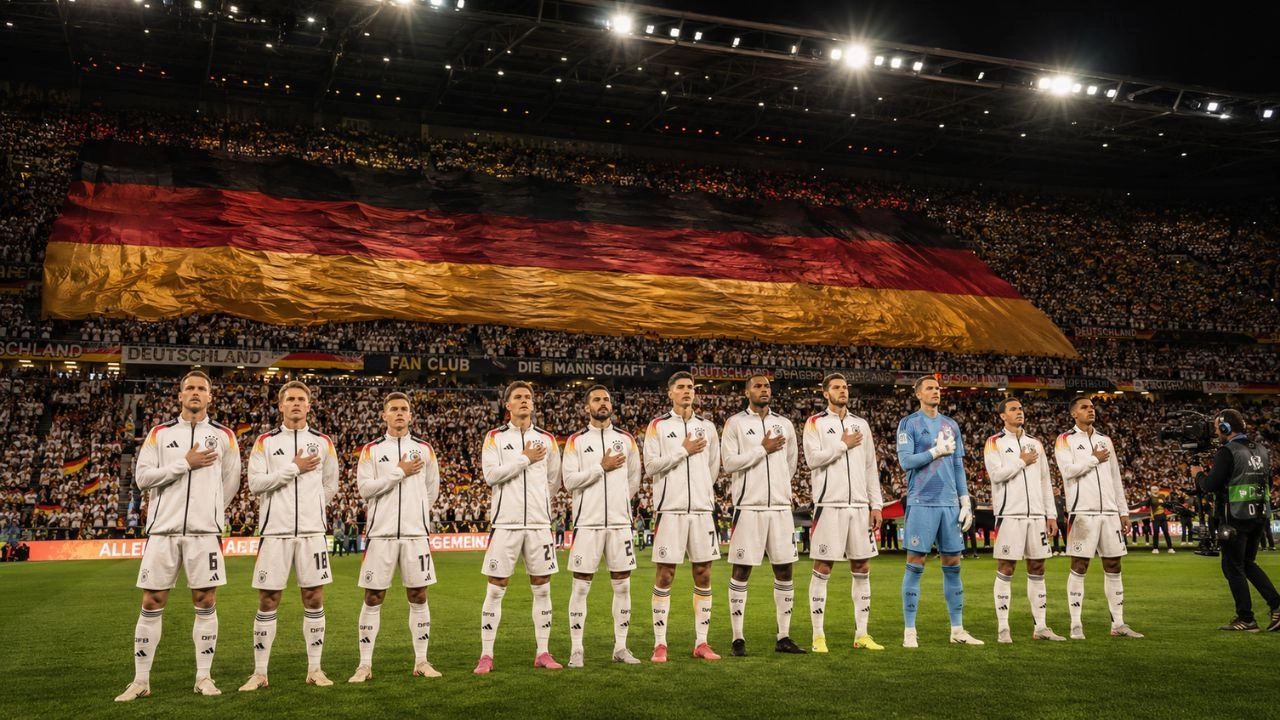
When Germany kicks off its 2026 World Cup against Curaçao on June 14 in Houston, you’ll hear the Deutschlandlied — but listen closely, because the players only sing the third verse. There’s a powerful reason for that, and it’s one of the most interesting backstories of any anthem at the tournament.
| Anthem | Deutschlandlied (Das Lied der Deutschen) |
| Music | Joseph Haydn (1797) |
| Lyrics | Hoffmann von Fallersleben (1841) |
| Official Since | 1922 (third stanza since 1952) |
| Language | German |
| Sung Part | Third stanza: “Einigkeit und Recht und Freiheit” |
Why Only the Third Verse Is Sung
The full poem has three stanzas, but modern Germany only uses the third. The famous opening line of the first stanza, “Deutschland, Deutschland über alles,” became tied to the Nazi era, so after World War II it was retired. Since 1952, the third stanza alone — “Einigkeit und Recht und Freiheit” (“Unity and Justice and Freedom”) — is the official national anthem.
What the Words Mean
“Einigkeit und Recht und Freiheit” isn’t just a lyric — it’s Germany’s national motto, even stamped on the edge of some German coins. The verse is a hopeful call for unity, justice and freedom as the foundation of the nation, with no mention of borders or conquest.
From Haydn to the World Cup
The melody is pure pedigree: it was composed by Joseph Haydn in 1797 (originally as an anthem for the Austrian emperor), and the lyrics were written by August Heinrich Hoffmann von Fallersleben in 1841. You can read the full history on Wikipedia.
More World Cup 2026 Anthems & Music
More World Cup 2026 national anthems: Mexico · USA · Canada · Brazil. See also our history of every World Cup anthem (1962–2026) and who sings the official World Cup 2026 song.
Germany at the 2026 World Cup
Germany are four-time world champions (1954, 1974, 1990 and 2014), so the “Deutschlandlied” is one of the most familiar sounds in tournament football. Die Mannschaft open their 2026 campaign against Curaçao on June 14 at Houston’s NRG Stadium before working through the rest of their group.
Watch the delivery: German players tend to sing the third stanza in a steady, unified way rather than belting it, which gives the moment a quietly powerful feel. After decades of rebuilding their relationship with the anthem, that understated tone is the whole point — it is a song about unity and freedom, sung without spectacle.
Frequently Asked Questions
What is Germany’s national anthem called?
It’s the “Deutschlandlied” (Song of the Germans), set to a melody by Joseph Haydn with lyrics by Hoffmann von Fallersleben.
Why do Germans only sing the third verse?
The first stanza became associated with the Nazi era, so since 1952 only the third stanza — ‘Unity and Justice and Freedom’ — is the official anthem.
What does the German anthem mean?
The sung third verse calls for unity, justice and freedom as the basis of the German nation.
Who composed the German anthem?
The melody was composed by Joseph Haydn in 1797; the lyrics were written by Hoffmann von Fallersleben in 1841.