
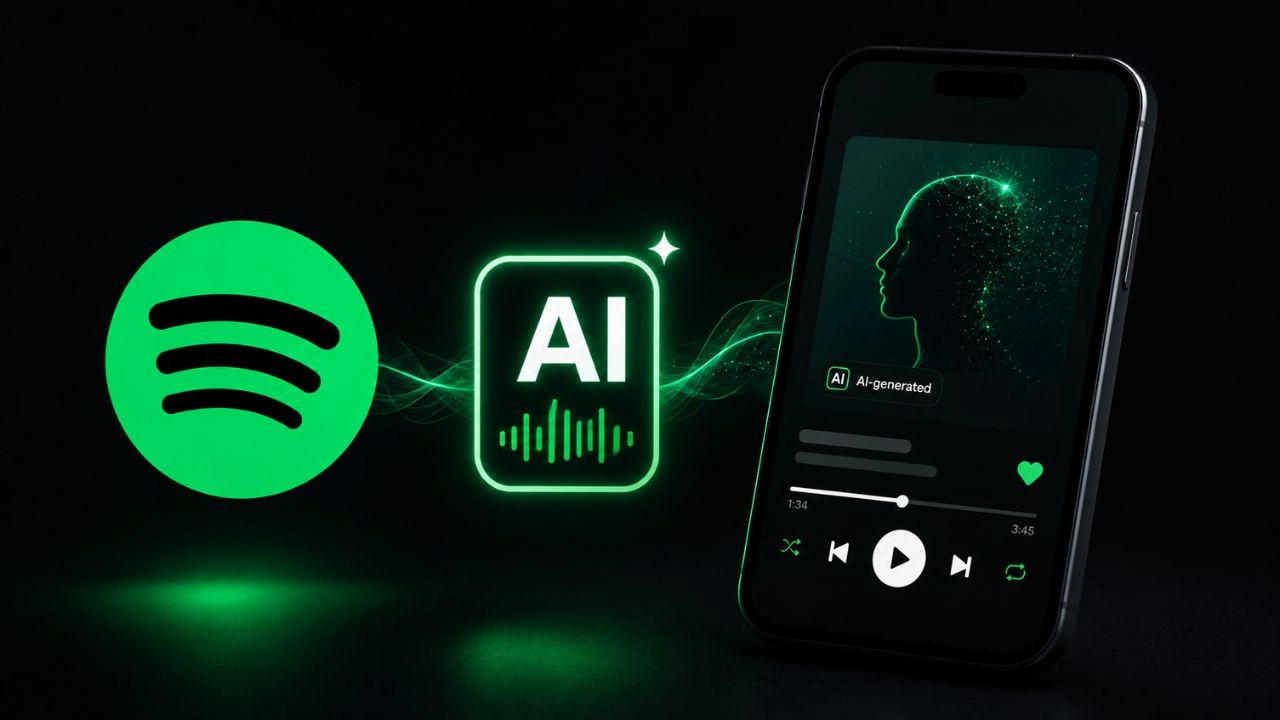
Five years writing about streaming royalties has taught me that policy changes from Spotify usually land with a press release and then quietly transform the way everyone makes records. The AI disclosure beta Spotify launched on April 16, 2026 looks like one of those. On paper it is a small interface tweak: artists can now declare exactly how AI was used on each of their tracks, and that information shows up in Song Credits on the mobile app. In practice it is the first serious attempt by a major streaming platform to make AI use visible to listeners at the song level.
Whether this becomes the industry standard or stays a Spotify-only feature is one of the most important questions in music right now. Here is what the feature actually does, how it sits within Spotify’s broader AI policy crackdown, and what working artists should do about it today.
What the AI Disclosure Beta Actually Does
The feature gives artists a structured form to declare specific AI contributions to a track. Disclosures are surfaced in Song Credits on mobile, alongside the human credits that already appear there (producer, writer, performer, engineer, label).
| Disclosure Category | What It Covers |
|---|---|
| AI Vocals | AI-generated, AI-cloned, or AI-modified vocal performance |
| AI Lyrics | Lyrics generated or significantly edited by AI |
| AI Production | AI involvement in mixing, mastering, arrangement, or instrument generation |
| AI Instruments | Generative AI used to create specific instrument sounds or stems |
| No AI | Explicit declaration that AI was not used in any capacity |
The disclosure is voluntary at launch. Spotify has not announced whether AI declarations will become mandatory or be used as a ranking signal. But the platform’s broader posture — the 75 million tracks removed for fraud, the new AI protection policies announced in September 2025 — suggests this is the foundation for a more aggressive set of rules to follow.
Why This Matters
- Listener transparency. Until now, AI involvement in a track has been invisible to anyone but the production team. Listeners had no way to know whether the “artist” they were streaming was a human, a project, or a generated avatar.
- Royalty integrity. The disclosures provide a paper trail that platforms can use to identify suspect uploads and prioritize human-created music in algorithmic surfacing.
- Trust building for ethical AI use. Not all AI use is fraud or cloning. Many working artists use AI tools for vocal alignment, stem separation, mastering, or texture generation in ways that do not displace human labor. Voluntary disclosure lets ethical AI use coexist with stronger anti-fraud enforcement.
- Setting a benchmark. Apple Music, Amazon Music, Tidal, and Deezer will face pressure to introduce equivalent features. Industry-wide AI disclosure is now plausibly 12–24 months away.
The Wider Spotify AI Policy Stack
The disclosure beta is part of a coordinated policy stack that has rolled out over roughly 18 months:
- September 2025: Spotify announced strengthened AI protections for artists, songwriters, and producers, including new takedown mechanisms for AI vocal cloning.
- Throughout 2025: Spotify reported the removal of approximately 75 million spam, fraud, and low-quality AI tracks from the platform.
- March 2026: Sony Music separately purged 135,000 AI deepfakes from various distribution channels.
- April 16, 2026: AI disclosure beta launched in Song Credits.
What This Means for Different Artists
For working session musicians and producers, the disclosure beta is a net positive. It puts pressure on uploaders to be honest about whether human session players were actually used, which has been a quietly disappearing line of work as AI instrumental tools have improved.
For soundtrack composers, the disclosure system raises new questions. Modern film scoring often involves software instruments, sample libraries, and AI-assisted orchestration tools. Where the line falls between “legitimate composer tools” and “AI production” will be genuinely contested. My read: software-instrument use is not what Spotify is targeting. Generative AI replacing human writing is.
For independent artists releasing through DistroKid, CD Baby, or TuneCore, expect distributor-level prompts on every new release asking for AI disclosures matching the Spotify schema. The major distributors will pass that data through automatically.
What You Should Actually Do
- If you are an artist on Spotify for Artists, opt into the beta and disclose accurately on every release going forward.
- If your catalog is entirely human-made, take the time to declare “No AI” on existing tracks. There is reason to believe Spotify will surface human-only catalogs more prominently in 2026 algorithmic playlists.
- Watch for the equivalent feature on Apple Music and Amazon Music. The first platform to follow will most likely be Apple, given their recent partnership-driven product moves around credits.
- If you are a listener and you care about supporting human-made music, start watching for the disclosure badge in Song Credits on the Spotify mobile app.
Frequently Asked Questions
When did Spotify launch its AI disclosure feature?
Spotify launched the AI disclosure feature as a beta on April 16, 2026. Artists can now declare specific AI contributions (vocals, lyrics, production, instruments) on each release, with the information visible in Song Credits on the Spotify mobile app.
Is the AI disclosure mandatory?
Not currently. The disclosure is voluntary at the beta stage. Spotify has not announced whether it will become mandatory, but the platform’s broader anti-fraud enforcement and 75 million track removals suggest a stricter regime is plausible in future.
How does Spotify decide what counts as “AI”?
Spotify’s disclosure schema covers four categories: AI vocals (generated, cloned, or modified), AI lyrics (generated or significantly edited), AI production (mixing, mastering, arrangement, or instrument generation), and AI instruments (generative instrument sounds or stems). A standard “No AI” declaration is also available.
Will Apple Music and Amazon Music add similar features?
Neither has officially confirmed AI disclosure features as of May 2026. Apple Music is widely expected to follow Spotify’s lead, given the platform’s recent moves around expanding song credits visibility. Industry-wide AI disclosure standards are plausible within 12 to 24 months.
Does this affect royalty payments?
Not directly. The disclosure does not change royalty rates. However, the disclosures provide data Spotify can use to identify and remove fraudulent AI catalogs, which over time should reduce the dilution of the royalty pool by bot-streamed AI tracks.
For more streaming and music industry coverage, check our soundtrack news section.