
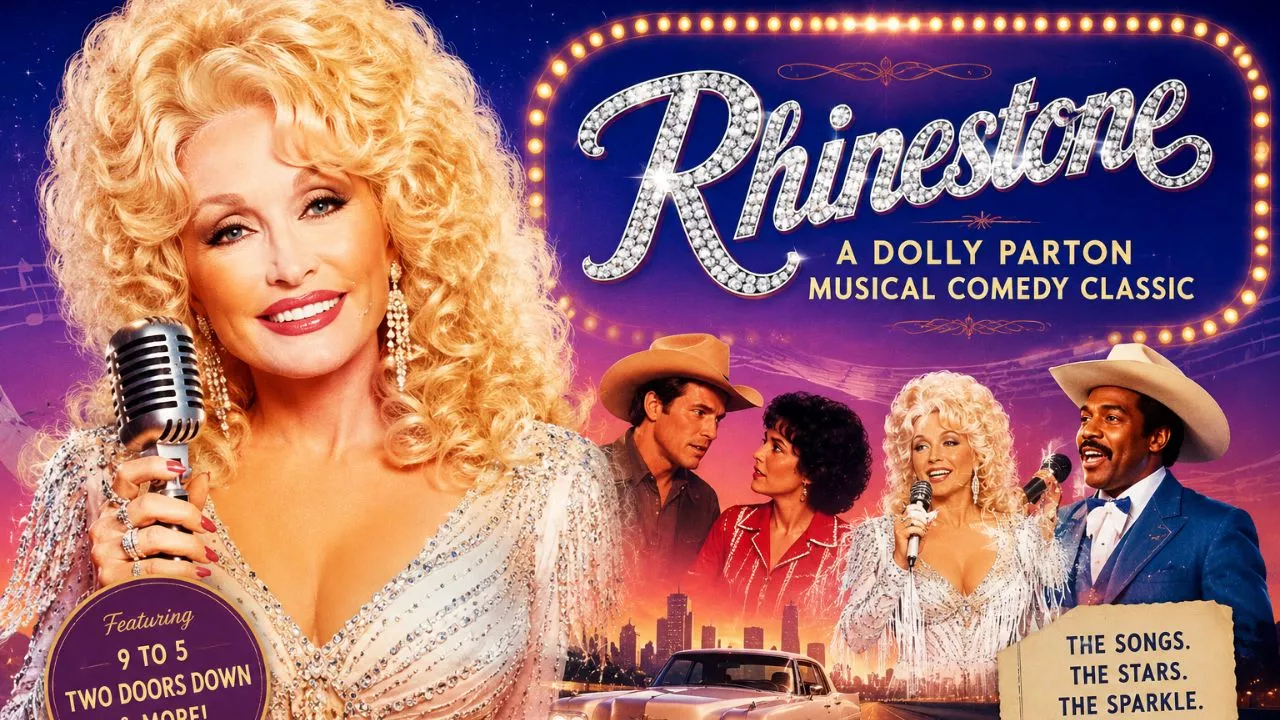
In 1984, country music legend Dolly Parton teamed with actor Sylvester Stallone in the musical comedy film “Rhinestone,” directed by Bob Clark. The film follows Jake Farris, a country music star played by Parton, who bets that she can transform an obnoxious New York City cab driver (Stallone) into a country singer in just two weeks. Though the film itself received mixed critical reception, the soundtrack became a commercial success, spawning some of the most memorable country hits of the 1980s.
Rhinestone Film & Soundtrack Details Table
| Detail | Information |
|---|---|
| Film Title | Rhinestone |
| Release Date | June 22, 1984 |
| Studio | 20th Century Fox |
| Director | Bob Clark |
| Starring | Dolly Parton, Sylvester Stallone, Richard Farnsworth, Ron Leibman |
| Soundtrack Album | Rhinestone (Original Motion Picture Soundtrack) |
| Record Label | RCA Records (RCA Nashville) |
| Soundtrack Release Date | May/June 1984 |
| Total Tracks | 14 songs |
| Runtime | 50 minutes |
| Genre | Country, Country-Pop |
| Platform Availability | Spotify, Apple Music, YouTube Music, Amazon Music |
Rhinestone Soundtrack Overview
The Rhinestone soundtrack consists of 14 songs, all composed by Dolly Parton, and was released in May 1984 on the RCA Nashville imprint. Dolly wrote thirteen of the fourteen songs on the album and performed nine of them as either solos or duets with Sylvester Stallone. The album captures the spirit of the film—a blend of traditional country, pop-country crossover appeal, and comedic country-rock moments that perfectly complement the movie’s tone.
The soundtrack marked a pivotal moment in Dolly’s career. In her autobiography “Dolly: My Life and Other Unfinished Business,” Parton credits her work on this soundtrack as some of her best, and the song “What a Heartache” as one of her personal favorites. Despite the film’s poor critical reception, the soundtrack proved that Dolly’s songwriting and vocal prowess could carry a project independent of external reviews.
Who Composed the Rhinestone Soundtrack? Dolly Parton
Dolly Rebecca Parton is an American singer-songwriter, actress, philanthropist, and businesswoman who has become one of the most accomplished and honored artists in music history. Born in eastern Tennessee as the fourth of twelve children, Parton grew up in modest circumstances that deeply influenced her songwriting—themes of resilience, family, and rural life permeate her catalog.
Dolly Parton’s Career Overview
Parton began her professional music career in the 1960s, working alongside country legend Porter Wagoner before launching a successful solo career in 1974. Her breakthrough came with iconic songs like “Jolene” (1974), “Coat of Many Colors” (1971), and the crossover smash “I Will Always Love You” (1974), which became a global phenomenon when Whitney Houston recorded it for “The Bodyguard” soundtrack in 1992.
Major Awards & Accolades
Dolly Parton has received various accolades including 11 Grammy Awards and a Primetime Emmy Award as well as nominations for two Academy Awards, six Golden Globe Awards and a Tony Award. She was honored with a star on the Hollywood Walk of Fame in 1984, the National Medal of Arts in 2004, the Kennedy Center Honors in 2006, the Grammy Lifetime Achievement Award in 2011, and the Jean Hersholt Humanitarian Award from the Academy of Motion Picture Arts and Sciences in 2025.
At the time of the Rhinestone release in 1984, Parton had already established herself as a force in both country and pop music. She has received various accolades, including eleven Grammy Awards and three Emmy Awards, as well as nominations for two Academy Awards, six Golden Globe Awards, and a Tony Award. Parton has sold more than 100 million records worldwide, making her one of the best-selling music artists ever. She has had 25 singles reach No. 1 on the Billboard country music charts, a record for a female artist (tied with Reba McEntire).
Songwriting Legacy
Parton has composed over 3,000 songs throughout her career. Her songwriting is known for its emotional authenticity, vivid storytelling, and accessibility across genres. The Rhinestone soundtrack represents her ability to craft music that serves both the narrative of a film and stands independently as chart-worthy material.
Dolly Parton Composer Filmography (Selected Film & Television Work)
| Year | Project | Role | Notable Details |
|---|---|---|---|
| 1980 | “9 to 5” | Actress & Composer (Title Song) | Oscar nomination for Best Original Song; two Grammy Awards |
| 1982 | “The Best Little Whorehouse in Texas” | Actress & Performer | Golden Globe nomination |
| 1984 | “Rhinestone” | Actress & Composer (Full Soundtrack) | 14-song original score; two top-10 country hits |
| 1989 | “Steel Magnolias” | Actress | Critical acclaim |
| 2018 | “Dumplin'” | Composer & Executive Producer | Netflix film |
| 2020 | “Dolly Parton’s Christmas on the Square” | Producer, Composer & Star | Emmy Award for Outstanding Television Movie |
| 2009 | “9 to 5: The Musical” (Broadway) | Composer & Creator | Tony nomination for Best Original Score |
Rhinestone Official Soundtrack Tracklist
The complete track listing for the Rhinestone soundtrack is as follows:
- “Tennessee Homesick Blues” – Dolly Parton (3:33)
- “Too Much Water” – Randy Parton (2:41)
- “The Day My Baby Died” – Rusty Buchanan (2:55) (Words: Phil Alden Robinson; Music: Mike Post)
- “One Emotion After Another” – Dolly Parton (3:37)
- “Goin’ Back to Heaven” – Stella Parton & Kin Vassy (4:16)
- “What a Heartache” – Dolly Parton (4:43)
- “Stay Out of My Bedroom” – Dolly Parton & Sylvester Stallone (3:32)
- “Woke Up in Love” – Dolly Parton & Sylvester Stallone (3:28)
- “God Won’t Get You” – Dolly Parton (3:37)
- “Drinkinstein” – Sylvester Stallone (2:54)
- “Sweet Lovin’ Friends” – Dolly Parton & Sylvester Stallone (3:12)
- “Waltz Me to Heaven” – Floyd Parton (3:08)
- “Butterflies” – Dolly Parton (4:16)
- “Be There” – Dolly Parton & Sylvester Stallone (3:27)
Total Album Runtime: 50 minutes
Composer Credits: All tracks are written by Dolly Parton, with the exception of “The Day My Baby Died,” which features words by Phil Alden Robinson and music by Mike Post.
Rhinestone Soundtrack Highlights: Notable Tracks & Analysis
“Tennessee Homesick Blues” – The Chart-Topping Lead Single
This track became one of two top 10 hits for Dolly on the Billboard Hot Country Songs chart, reaching No. 1 on the U.S. chart. The song is an archetypal country number that showcases Dolly’s ability to craft relatable narratives about longing and homesickness. Its infectious melody and traditional country arrangement made it the perfect introduction to the soundtrack’s sonic landscape.
“God Won’t Get You” – The Follow-Up Hit
“God Won’t Get You” began as a song titled “Where Stallions Run” that Dolly had written for co-star Burt Reynolds to perform in “The Best Little Whorehouse in Texas.” The song was ultimately not included in that film, so Dolly reworked it into “A Cowboy’s Ways” for her 1983 album “Burlap & Satin.” Dolly recycled the melody for “God Won’t Get You” in 1984. The single peaked at number 10 on the Billboard Hot Country Songs chart.
“What a Heartache” – Dolly’s Personal Favorite
In her book, “Dolly: My Life and Other Unfinished Business,” Dolly credits “What a Heartache” as one of her personal favorites. The song appears on two of Dolly’s solo albums, “Eagle When She Flies” (1991) and “Halos & Horns” (2002), underscoring its enduring significance in her catalog. The track is a tender ballad that demonstrates Dolly’s emotional depth and her gift for crafting songs that resonate across generations.
Duets with Sylvester Stallone: “Stay Out of My Bedroom,” “Woke Up in Love,” “Sweet Lovin’ Friends,” & “Be There”
These four duets represent the comedic and romantic heart of the film. The contrast between Parton’s polished, powerful vocals and Stallone’s deliberately amateur singing creates moments that are both humorous and strangely endearing. Stallone’s participation on these tracks was integral to the film’s narrative arc—his character’s journey from non-singer to someone capable of holding a tune with Dolly provides the film’s emotional throughline.
“Drinkinstein” – Stallone’s Solo Showcase
Sylvester Stallone’s solo track is one of the film’s most memorable (and unintentionally comedic) moments. The song’s humorous title and Stallone’s over-the-top vocal delivery make it a standout for audiences seeking novelty entertainment.
“Butterflies” – A Gentle Country Moment
This mid-tempo ballad provides a quieter moment on the album, allowing Dolly’s voice to shine in a more intimate setting. The song captures the vulnerability that underlies much of her best work.
Rhinestone Licensed Songs & Needle Drops
Note on Film Soundtrack: The Rhinestone soundtrack is primarily composed of original songs written by Dolly Parton for the film. The film is based on the 1975 hit song “Rhinestone Cowboy” written by Larry Weiss. While this iconic song provides the thematic foundation for the movie, it does not appear on the official soundtrack album—the film instead features Dolly’s original compositions throughout.
Rhinestone Chart Performance & Commercial Reception
The album debuted at number 54 on the Billboard Top Country Albums chart dated July 28, 1984. It peaked at number 32 on the chart dated September 8, its seventh week on the chart. The album charted for a total of 17 weeks. The album also peaked at number 135 on the Billboard 200.
Despite the film’s critical failure, the soundtrack’s chart success demonstrates the power of Dolly’s star and songwriting ability to transcend the vehicle through which the songs are introduced.
Where to Listen to the Rhinestone Soundtrack
The Rhinestone soundtrack is widely available across major streaming platforms. You can stream the complete album on Spotify, Apple Music, YouTube Music, Amazon Music, and Tidal. The soundtrack was reissued digitally on December 4, 2015, making the full remastered audio available to new listeners. Physical copies remain available through independent record stores and online retailers specializing in vintage country soundtracks.
Rhinestone Soundtrack: Frequently Asked Questions
1. Did Dolly Parton compose all the songs on the Rhinestone soundtrack?
Dolly Parton wrote all tracks except “The Day My Baby Died,” which features words by Phil Alden Robinson and music by Mike Post. Thirteen of the fourteen songs are original Dolly Parton compositions.
2. Which songs from Rhinestone became chart hits?
“Tennessee Homesick Blues” went to No. 1 on the U.S. Billboard Hot Country Singles chart, and “God Won’t Get You” reached the top 10 on the same chart. Both songs demonstrated the commercial viability of Dolly’s material independent of the film’s reception.
3. How many tracks are on the Rhinestone soundtrack?
The film’s soundtrack consists of 14 songs. The album runs approximately 50 minutes in total length.
4. Did Dolly Parton receive a Grammy nomination for Rhinestone?
Dolly received a GRAMMY nomination for Best Female Country Vocal Performance with the song “Tennessee Homesick Blues.” This recognition underscored the quality of her songwriting and vocal performance on the track.
5. When was the Rhinestone soundtrack released?
The soundtrack was released in May 1984 on the RCA Nashville imprint. The official release date was June 18, 1984, by RCA Records.
6. What does Dolly say about the Rhinestone soundtrack in her autobiography?
In her book “Dolly: My Life and Other Unfinished Business,” Parton credits her work on this soundtrack as some of her best and the song “What a Heartache” as one of her personal favorites. Despite the film’s poor critical reception, Dolly has consistently praised the quality of her musical contributions.
7. Is the Rhinestone soundtrack available on streaming services?
Yes, the complete Rhinestone soundtrack is available on all major streaming platforms including Spotify, Apple Music, YouTube Music, Amazon Music, and Tidal. The album was made available digitally for the first time on December 4, 2015.
8. Why did Dolly Parton re-record “What a Heartache” on later albums?
Dolly has re-recorded “What a Heartache” twice since its original appearance on the Rhinestone soundtrack: first in 1991 for the “Eagle When She Flies” album, and again in 2002 for “Halos & Horns.” These re-recordings demonstrate the song’s enduring place in her artistic evolution.