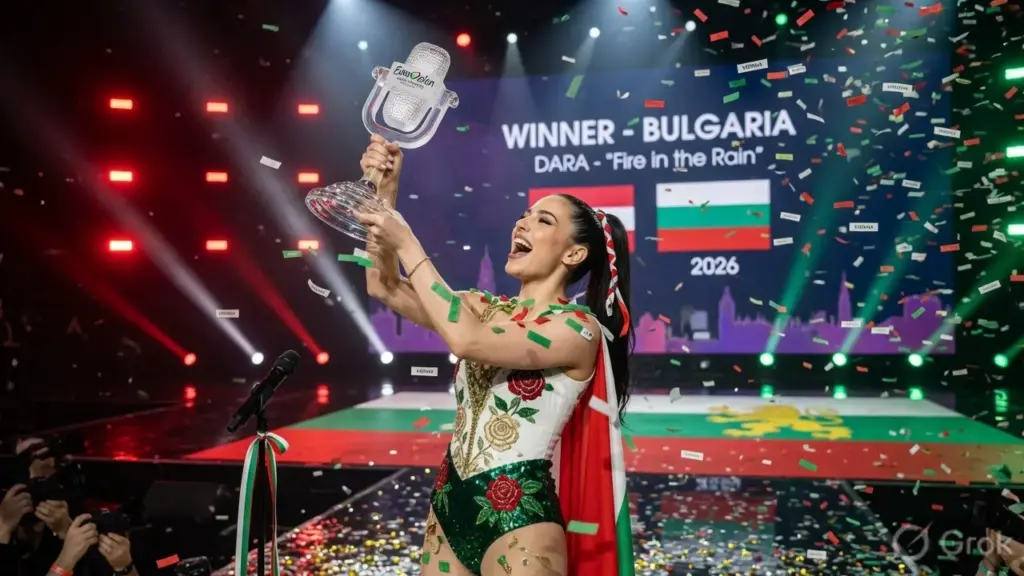
I have been covering soundtracks, song contests, and the strange in-between worlds of pop music for the last five years, and even in that short window I cannot remember the last time a Eurovision result actually made the room I was sitting in go quiet. Bulgaria winning the Eurovision Song Contest in 2026 with “Bangaranga” by Dara, on May 16 in Vienna, did exactly that. First-ever Bulgarian win. Twenty-one years after their first attempt. A song that was already a fan-favourite betting pick going into the final, but absolutely no one’s certified frontrunner.
If you missed the broadcast or you just want the clean facts before the social-media noise drowns it out, here is everything I have pulled together from the official Eurovision scoreboard, the EBU press conference, and the two days I spent listening to nothing but the final twenty-six entries. This is a real moment for Bulgaria, and quite possibly for what kind of song wins Eurovision in the next decade.
The Headline: Bulgaria Finally Did It
Bulgaria has been knocking on the Eurovision door for years. Their best result before this was second place in 2017 with Kristian Kostov’s “Beautiful Mess.” They came close again with Poli Genova’s “If Love Was a Crime” in 2016 (fourth). Outside of those two peaks, the country has spent most of its Eurovision life in the bottom half of the leaderboard or, more painfully, withdrawn entirely for budget reasons. So this win is not just a result. It is a generational payoff.
The 70th edition of the contest was hosted by Vienna’s Wiener Stadthalle, with the EBU operating the show after Switzerland declined to host following Nemo’s 2024 win cycle. Vienna is a Eurovision city — you can feel it on Mariahilfer Straße during contest week — and the production reflected that. The stage was minimal, song-first, with the kind of camera blocking that lets a vocal performance breathe instead of disappearing behind drone shots.
Top 6 Final Results (2026)
| Place | Country | Artist | Song | Total Points |
|---|---|---|---|---|
| 1 | Bulgaria | Dara | "Bangaranga" | 516 |
| 2 | Israel | (2026 entrant) | — | 343 |
| 3 | Romania | Alexandra Căpitănescu | "Choke Me" | — |
| 4 | Australia | Delta Goodrem | "Eclipse" | — |
| 5 | Italy | Sal Da Vinci | "Per Sempre Sí" | — |
| 6 | Finland | (Finnish duo) | — | — |
Bulgaria’s 516 was a comfortable margin over Israel’s 343, but the gap looks bigger than the night actually felt. Israel was ahead with the juries until very late in the show. The public televote swung it: Bulgaria pulled in 312 public points on top of 204 from the national juries, which is the kind of dual-mandate win that very few Eurovision champions can claim.
What “Bangaranga” Actually Sounds Like
If you have not heard the song yet — you will, repeatedly — here is my honest snapshot. “Bangaranga” is built on a Balkan-rooted folk hook, sung mostly in Bulgarian, with a percussion engine that sounds closer to traditional kuchek rhythm than to the four-on-the-floor template that dominates modern Eurovision pop. Dara delivers the chorus in a kind of declarative call-and-response that lands somewhere between INNA-style Balkan pop and the more rooted folk that Sevdaliza or Ramazan Sahin have been working in for the last few years.
It is a strange song to find on top of a Eurovision scoreboard. It is not the obvious arena anthem. It is not a power ballad. It does not lean into a big modulation in the last chorus. What it does have is identity. From the first two bars, you know what country sent it. That, more than anything, is what voters seem to have rewarded.
Who Is Dara?
Dara is a Bulgarian pop artist who first broke through on the country’s X Factor in 2015. She has spent the last decade releasing music in Bulgarian and Balkan-Slavic crossover styles, working with producers across Sofia, Belgrade, and Skopje. Eurovision has been on her radar publicly for at least three years, and BNT — Bulgarian National Television — selected “Bangaranga” through an internal process at the start of 2026 rather than a public national final.
What I keep coming back to is how confident she was on the stage. Eurovision performances usually live or die in the camera blocking; you can have the best song in the running and lose because the director cuts away at the wrong moment. Dara performed “Bangaranga” like she had rehearsed it three thousand times, which she probably had. Stage choreography stayed simple. Vocals were live and tight. Costume kept the colour palette tied to the song’s rural-Bulgarian visual concept without slipping into folk-costume kitsch.
What This Win Means for Eurovision (and Soundtracks)
Eurovision has been quietly drifting back toward songs with strong cultural identity over the last few years. Nemo’s “The Code” in 2024, Loreen’s “Tattoo” in 2023, Kalush Orchestra’s “Stefania” in 2022. Even the 2020 cancellation cycle was full of entries leaning into regional sound. “Bangaranga” continues that trajectory in a much more pronounced way: it is the first time a song mostly performed in Bulgarian has won the contest.
For the larger soundtrack world — which is what I actually spend most of my time covering — this matters. Eurovision winners reliably feed into film and TV needle-drops within twelve to twenty-four months. “Euphoria” (Loreen 2012) wound up in everything from Skam to streaming-original credits. “Stefania” was placed in Ukrainian-set documentaries. Expect “Bangaranga” to surface in everything from European-set thrillers to indie director needle-drop choices by mid-2027. The instrumental version, especially, has the kind of percussion bed that music supervisors love to drop under chase sequences.
Where to Listen to “Bangaranga”
- Spotify — the studio version is on Eurovision’s official 2026 compilation playlist plus Dara’s artist page
- Apple Music — full studio version, live-from-Vienna version, and an extended instrumental remix
- YouTube — the official Eurovision YouTube channel has the live performance in 4K (typically the most-watched clip in the days following any final)
- Eurovision.tv — the EBU’s own site hosts the official video plus the rehearsal package
Frequently Asked Questions
Who won Eurovision 2026?
Bulgaria won Eurovision 2026, with Dara performing “Bangaranga”. It is Bulgaria’s first-ever Eurovision win after debuting at the contest in 2005. The final was held on Saturday, May 16, 2026, at the Wiener Stadthalle in Vienna, Austria.
How many points did Bulgaria get at Eurovision 2026?
Bulgaria received 516 total points — 204 from the national juries and 312 from the public televote. The runner-up, Israel, scored 343 points.
What language is “Bangaranga” in?
“Bangaranga” is performed mostly in Bulgarian, with a few crossover phrases. It is the first majority-Bulgarian-language song to win the Eurovision Song Contest.
Where will Eurovision 2027 be hosted?
By the contest’s rules, the winning country gets first refusal to host the following year. The 2027 edition is expected to be hosted in Bulgaria, with Sofia widely tipped as the likely host city, though the EBU has not yet officially confirmed the venue at the time of writing.
Is “Bangaranga” available on Spotify and Apple Music?
For more music news and soundtrack coverage, check our soundtrack news section, or browse by streaming service from the main menu.